Overview
In this test, you'll create a new Revit project using the Project Template that Autodesk provides for your discipline.
Steps to Follow
‣
Create a New Revit Project
- Open the Revit 2027 application.
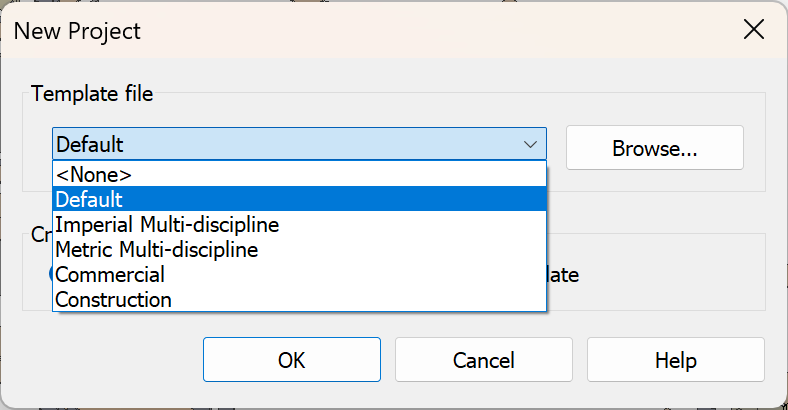
- On the Revit home page, click the New... button in the Models section of the navigation bar, then choose the Imperial Multi-discipline template from the New Project dialog
- Click OK to create the new project.
- Confirm that the new project has been created with no error messages.
- For Revit 2027, download the US English Content for Revit 2027 using this link:
- For other languages, go to this link, then click the Libraries tab and select the language you’d like to install.
- Run the RVTCPENU.exe (or app with a similar name for the language you selected), and accept the default choices to install the Autodesk Content Library in your Revit application.
💡
If a new project file is created with no error messages, this confirms that the Revit application and the base content libraries (which include the project templates) are installed properly on your computer.

If you receive an error message or a dialog asking you to locate the template files, the Revit Project Templates are not installed at the expected location. If this happens:
‣


‣
Confirm that the Revit Library is Installed on Your Computer
- In the new Revit project, switch to the Insert tab.
- Open the Load Family tool (Insert > Load from Library > Load Family).
- If you do not see this list of folders, the Autodesk Sample Content libraries are not installed. If this happens:
- For Revit 2027, download the US English Content for Revit 2027 using this link:
- For other languages, go to this link, then click the Libraries tab and select the language you’d like to install.
- Run the RVTCPENU.exe (or app with a similar name for the language you selected), and accept the default choices to install the Autodesk Content Library in your Revit application.
💡
This should open the Revit content library installed on your computer, and you should see a list of folders including Annotations, Boundary Conditions, Casework, and so on.
‣
Place a Revit Library Component in Your Project
- Navigate to the Furniture > Seating folder (or the equivalent for your language) in the content library and load any chair family into your project.
- Place an instance of the new chair component in the Revit drawing area.
‣
Document and Send to the Course Assistant
- Open the Model Text tool (Architecture > Model > Model Text)
- Place a model text element displaying your name in the drawing area next to the chair component.
- Capture a screenshot of the drawing area window showing the chair component and your model text.
- Send it to the course assistant.
What's Next
When you've completed this test, proceed to:
Test 1B: Open an Existing Revit Model