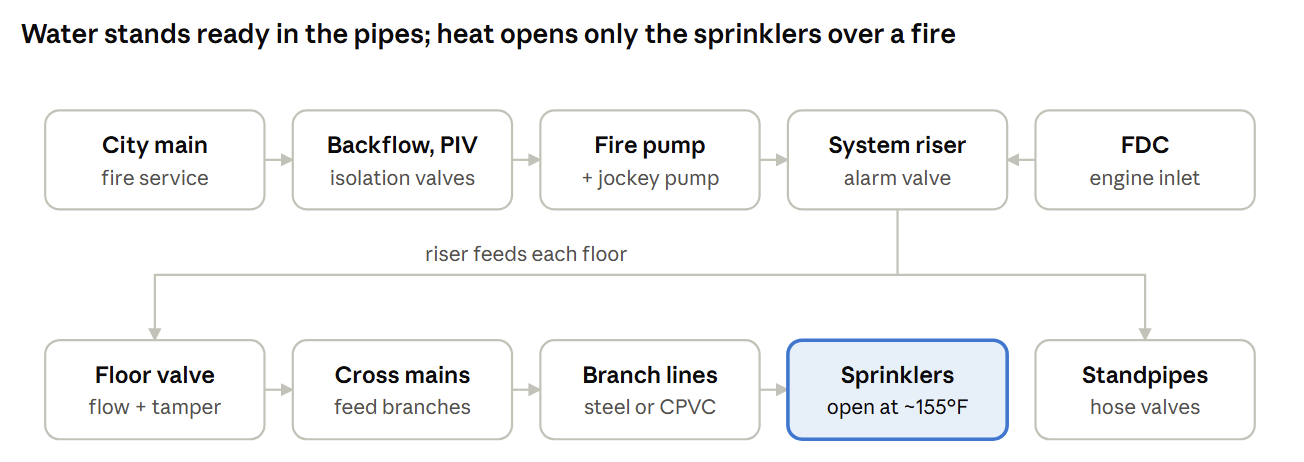
Fire protection piping stays full of water (or air) at all times so that a sprinkler opening over a fire discharges water within seconds. It is designed to NFPA 13 (sprinklers), NFPA 14 (standpipes) and NFPA 20 (fire pumps).
‣
Source
Fire service line from the utility main, separate from the domestic service, often through a detector-check meter.
Backflow preventer (double-check or RPZ) and a post indicator valve (PIV) or OS&Y gate valve outside.
Fire pump (electric or diesel) with a jockey pump to hold pressure, where city pressure is not enough; storage tanks where supply is limited.
Fire department connection (FDC): an exterior inlet so the fire engine can pump into the system.
‣
Distribution
System riser with the main control valve, alarm check valve, waterflow switch, pressure gauges and main drain.
Floor control valve assembly on each floor in high-rises (tamper switch, flow switch, test and drain).
Cross mains feeding branch lines, arranged as tree, loop or grid; black steel (Schedule 10/40) or CPVC in light hazard areas.
Standpipes: risers in exit stairs with hose valves at each landing (Class I for firefighters, Class II/III with hose for occupants).
Inspector's test and auxiliary drains for testing and draining.
‣
Terminals
Sprinkler heads: pendant, upright, sidewall and concealed; each opens on its own when a glass bulb or fusible link reaches its rating (commonly 155°F to 165°F).
Hose valves and cabinets on standpipe systems.
System types
Type
Pipe holds
Used where
Wet pipe
Water
Most heated buildings; simplest and most common
Dry pipe
Compressed air, water held back by a dry-pipe valve
Unheated garages, attics, loading docks
Preaction
Air; water released only after a detector also trips
Data centers, museums, archives
Deluge
Open heads; water flows from all at once
Aircraft hangars, fuel and chemical areas
The city main or fire pump keeps the system pressurized, the fire department can boost it through the FDC, and the riser splits water to each floor's sprinklers and the stair standpipes.