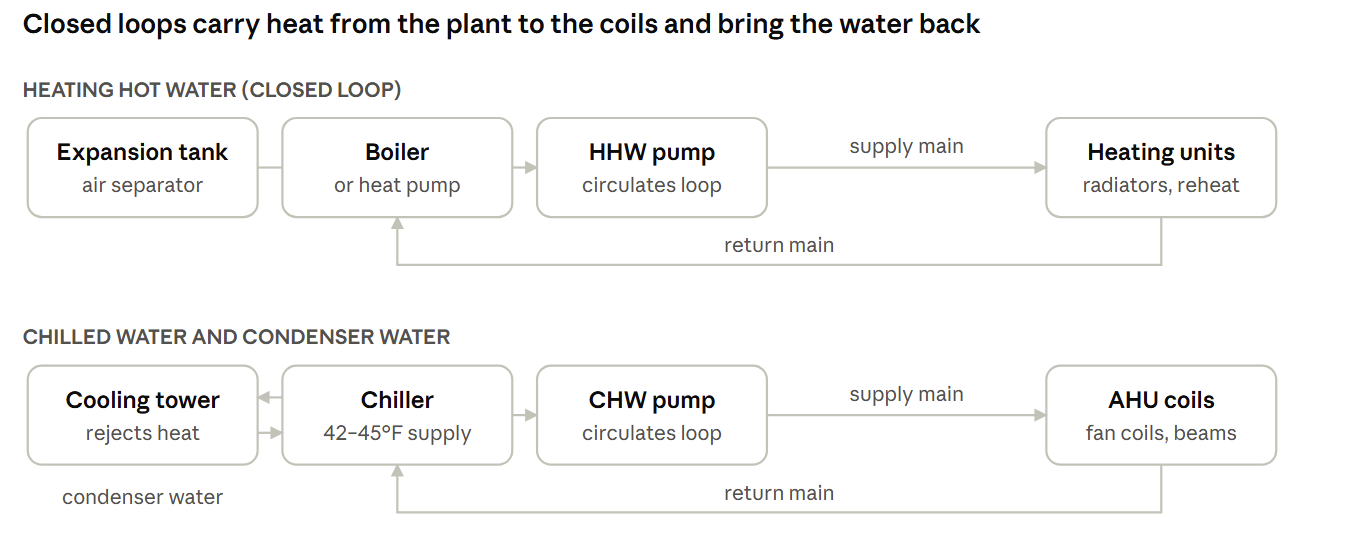
Hydronic systems are closed loops that move heat with water (or glycol) between central plant equipment and terminal units, then return it to be reheated or recooled. Unlike domestic water, the same water circulates continuously and is chemically treated.
‣
Source (central plant)
Heating hot water (HHW): boilers (condensing or non-condensing), heat pumps, or heat exchangers from district steam. Supply is typically about 180°F for older non-condensing systems and 120°F to 140°F for condensing boilers and heat pumps.
Chilled water (CHW): electric chillers (air- or water-cooled) or absorption chillers, typically supplying about 42°F to 45°F.
Condenser water (CW): an open loop carrying heat from water-cooled chillers to a cooling tower on the roof.
Pumps (primary, secondary or variable primary), expansion tank, air separator, makeup water with backflow preventer, and a chemical feed pot or treatment system.
‣
Distribution
Supply and return mains and risers, in a two-pipe system (heating or cooling) or four-pipe system (both at once).
Control valves (two-way or three-way) at each coil, balancing valves, isolation valves, strainers and air vents at high points.
Black steel, copper or press-fit pipe; insulated (chilled water with a vapor barrier).
‣
Terminals
Air handling unit (AHU) coils, fan coil units, VAV reheat coils and unit heaters.
Radiators, baseboard fin-tube, radiant floor and chilled beam systems.
Process loads such as data-center cooling units.
Each loop pumps conditioned water out to the coils and returns it to the boiler or chiller; the chiller's heat leaves the building through the condenser water loop and cooling tower.