Step 1 - Generative Design Framework
A very brief description of the design decisions from Step 1 following the Generative Design Framework.
- Structural Design Optimization
- Design Variables
- Quantity of material
- Factor of safety
- Evaluators
- Minimizing the quantity of material leads to an optimized design
- The level of safety depends on the project, but must be above 1 to be a safe design.
- Constructability cost, which is defined by cost of the design work and construction estimated hours.
- Most Important Tradeoffs to Consider
- There exists a tradeoff between safety in a design and the quantity of material. A safer design often requires higher levels of material.
- As a design becomes more optimized, it often becomes more complex and is therefore harder to construct which may in turn increase costs from design work. It is therefore important to balance the savings from using less material to the cost of implementing a more complex design, such as using non-integral measurements of shapes. For example, using a 1.436” level of concrete cover instead of a 1.5”.
- Bridge Location / Preliminary Design
- Design Variables
- Start point of the bridge
- End point of the bridge
- Number of lanes.
- Height of bridge.
- Evaluators
- Levels of potential traffic flow.
- Total material usage of the project
- Construction cost
- Flood protection / resiliency.
- Most Important Tradeoffs to Consider
- The most important tradeoff to consider is the cost between the alternatives and the impact / use of the bridge. A cheap bridge that has low traffic flow over it is likely not an ideal solution.
- The height and length of the bridge are also trade-offs between one another as a taller bridge often requires more length to obtain that height.
- A more expensive bridge can support higher levels of traffic flow.
- A taller bridge is more expensive but more resilient.
- Seismic Design
- Design Variables
- Building stiffness
- Building mass
- Lateral force resisting system (Braced frames, BRBs, moment frames)
- Strength of the system, namely when yielding will occur
- Evaluators
- Period of the structure. This is dependent on the height and number of stories of a building, along with its stiffness and mass.
- Lateral displacement
- Peak roof acceleration
- Building cost
- Ductility
- Most Important Tradeoffs to Consider
- A stiffer building tends to cost more but allows for a decrease in displacement. Yet, this could also lead to the system needing to be designed for a higher acceleration. This is also indicated by a lower period of the building
- More ductile systems can resist more forces, but usually involve lower strengths which can lead to more damage and more overall costs in the building’s lifetime
- A stiffer building is often less ductile.
Step 2 - Generative Design Study
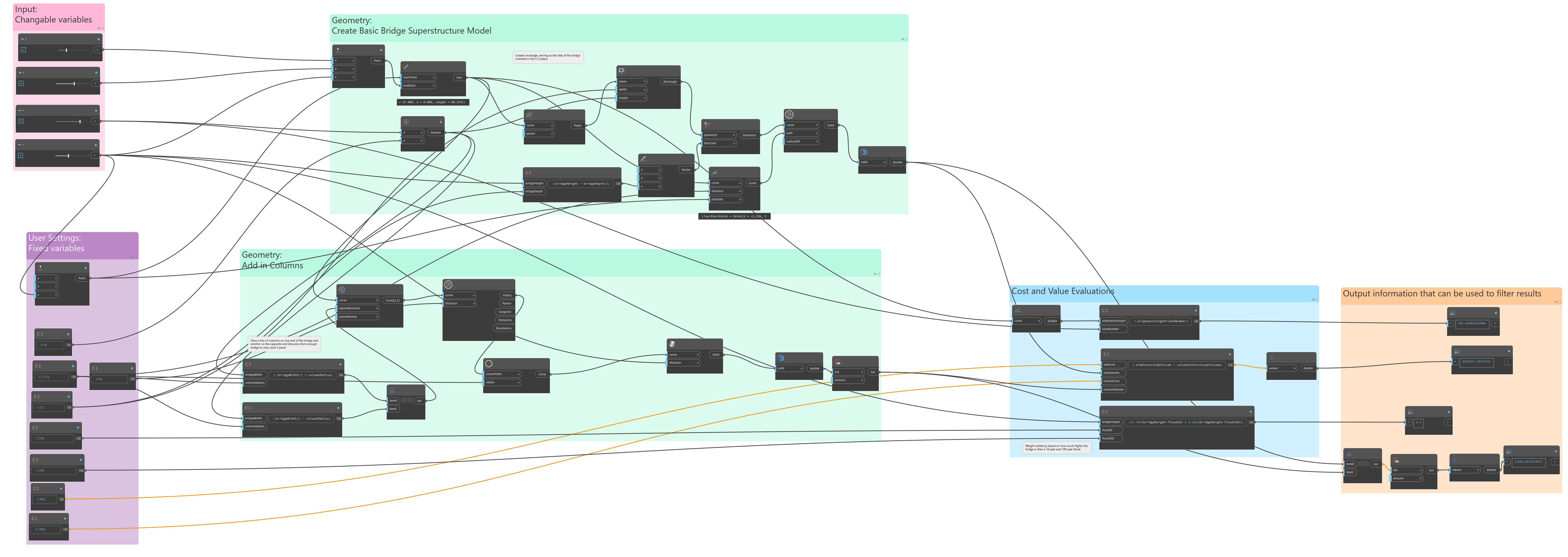
While I am enrolled in 3 units, I decided to explore 4 design variables and 4 evaluators for extra credit.
- Bridge Location / Preliminary Design
- Design Variables
- Start point of the bridge
- Will be set to the origin for this case
- End point of the bridge (X and Y coordinate will allow to be varied)
- Length of crossing. This directly impacts the length of the bridge and therefore the need for different girders and piers. A longer bridge often needs larger members.
- Number of lanes. A bridge with more lanes is more expensive to build, but it can support more cars and allow for higher levels of traffic flow.
- Height of bridge. This variable is especially critical in flood prone regions where bridges can serve as lifelines to communities.
- Evaluators
- Levels of potential traffic flow. This helps to indicate the usage of the bridge in various regions due to proximity to existing infrastructure and commonly taken routes.
- This can be modeled as the length of the alignment of the top of the slab times the number of lanes specified. This then gives a relative measure of the available travel area provided, which is sought to be maximized.
- Total material usage of the project, which is a function of the length, height, and width of the bridge as well as the member sizings and coordination efforts.
- This value can be the volume of the entire structure.
- Construction cost. Specific costs can be assigned to different members (for this model, just the slab and the columns) and then added together.
- Flood protection / resiliency. A higher bridge serves to better protect the structure and ensure serviceability during flooding.
- Most Important Tradeoffs to Consider
- The most important tradeoff to consider is the cost between the alternatives and the impact / use of the bridge. A cheap bridge that has low traffic flow over it is likely not an ideal solution.
- The height and length of the bridge are also trade-offs between one another as a taller bridge often requires more length to obtain that height.
- A more expensive bridge can support higher levels of traffic flow.
- A taller bridge is more expensive but more resilient.
Step 3 - Generative Design Study Results

This scatterplot showcases the 4 optimization outputs that were tested. The y-axis details the traffic flow, with favorable values at the top. The X-axis indicates resiliency, with favorable values to the right. The size of the scatterplot variables are determined by the construction cost, with the smaller sizes more favorable. Lastly, the color is controlled by the material usage where the red side of the spectrum is the more favorable. This graph showcases how material usage and construction cost are very similar and follow similar trends while traffic flow and resiliency are more randomized. For the most part, a higher construction cost is associated with higher traffic flows, but this trend is less strong in regards to resiliency with high construction costs and traffic flow being associated with the whole range of values for resiliency. The favorable location to be in this graph is in the upper right corner, but as resiliency is only important to a certain extent, the middle of the graph likely presents the most viable options with the lighter green and smaller circles. This information would help to guide what designs perform best across the most metrics and allow for preliminary design options to be presented to the contractor or client.
