BIMtopia
/CEE 176G/276G | Summer 2023:
Sustainability Design Thinking
CEE 176G/276G | Summer 2023: Sustainability Design Thinking
CEE 176G/276G | Summer 2023:
Sustainability Design Thinking
CEE 176G/276G | Summer 2023:
Sustainability Design Thinking

CEE 176G/276G | Summer 2023: Sustainability Design Thinking

‣
Remote Access > Zoom
‣
Remote Access to Class Sessions

As a member of our design studio, you are expected to attend all class sessions in person.

If you ever cannot attend the live class session, please join us online using this link:

g

or connect using the Zoom link in Canvas:

image

And if you cannot attend join online at the live class time, you are expected to view the recording of the session prior to the next class session.

‣
Always Open Meeting Space

Our studio has an always open meeting space — think of it as a conference room that you can jump into at any time. We’ll be using this for open office hours (versus schedule appointments), and you’re welcome to use this online meeting space at any time.

https://bit.ly/CEE176G-MeetingSpace

You can also create your own private meetings and invite collaborators to join you using Zoom.

🖥 Logistics

‣
Welcome to CEE 176G/276G!

Hope you’re excited for the start of Summer Quarter! I wanted to share some important information to help you get ready for our first class session on Monday, June 26 at 2:30 PM.

The class will be meeting in room Wallenberg Hall (Building 160- Room 124 — at the front edge of the Stanford Quad) on Monday and Wednesday afternoons from 2:30 to 4:20 PM Pacific.   

Class Sessions

These class sessions will include a combination of discussions, case study presentations, interactive team exercises, and design studio working sessions. And, as a member of our design studio, you are expected to attend all class sessions in person. So, while much of your project work will be completed outside of class time, you are expected to attend all class sessions in person at the scheduled class times.

If you ever cannot attend the live class session, please join us online using this link:

https://bit.ly/CEE176G-ClassSessions

Design Projects

The class is organized into three modules -- each of which features a design project that will give you an opportunity to exercise and apply your design thinking skills to a design and propose a solution that promotes sustainable behaviors and practices.

Each design project will each require about 7 hours of work per week outside of the class sessions. 

You’ll be working independently on Design Project 1, then in small teams on Design Projects 2 and 3, to share a proposed design that:

  • meets the needs that you or your team identifies
  • illustrates your strategy for approaching the challenges and opportunities you uncover
  • demonstrates your application of the design thinking process
  • makes a measurable impact on improving sustainable behaviors and practices

Login to Canvas and Join our Slack Workspace

We’ll be using Slack as the primary method for quickly messaging each other in this studio.

So, please login to Canvas (https://canvas.stanford.edu), then join our class Slack workspace by clicking the Slack link in the left toolbar in Canvas. This will get you set up to receive all the course messages and announcements in the Slack application or web interface.

image

Think of Slack as an open channel for sharing your questions, insights, and inspirations with the entire studio. If you have a question that you think any of the other studio members might also have, please post it to one of the open Slack channels.

Looking forward to meeting you and getting started on our sustainable design journey on Monday afternoon!

‣
Class Contact Info

Please confirm your contact information and let us know your preferred name by editing your row this shared Google Sheet:

CEE 176G/276G - Sustainable Design Thinking - Contact Info - Summer 2023

Sheet1 Full Name,Preferred Name,Stanford E-Mail Address,Other E-Mail Address (GMail),Enrolled In,Program,Enrolled in Axess? Alabdulkareem,Lina Khalid M,linaak@stanford.edu,CEE 176G,Graduate Summer Visitor - GR Sum Visitor (SV),yes,176 Albabtain,Hind Hareth Y,hindhb@stanford.edu,CEE 176G,Grad...

//ssl.gstatic.com/docs/spreadsheets/favicon3.ico

docs.google.com

CEE 176G/276G - Sustainable Design Thinking - Contact Info - Summer 2023
‣
Getting Set Up
CEE 176G/276G | Winter 2024: Course SyllabusUsing “How Might We?” Questions to Identify Alternative StrategiesUsing “How Might We?” Questions to Identify Alternative StrategiesCEE 176G/276G | Winter 2024: Course Logistics CEE 176G/276G | Winter 2024: Meet Your Teaching Team
‣
Home Pages
‣
Notion - Collaborative Design Studio Workspace
bit.ly

bit.ly

https://bit.ly/CEE176G-2023

‣
Canvas Home Page
canvas.stanford.edu

canvas.stanford.edu

‣
Messaging / Q&A > Slack Workspace

We’ll be using Slack as the primary method for quickly messaging each other in this studio.

‣
Joining our Slack Workspace

Please join our class Slack workspace by clicking the Slack link in the left toolbar in Canvas.

image
‣
Using our Slack Workspace

Once you’ve joined the workspace, you can access it through the Slack app or this link:

https://su-174732.slack.com

Think of Slack as an open channel for sharing your questions, insights, and inspirations with the entire studio. If you have a question that you think any of the other studio members might also have, please post it to one of the open Slack channels.

Slack also offers a direct messaging feature, but please use this only for questions that are truly unique and private — things that should not be shared.

‣
Google Drive Shared Workspace

We’ll use a shared Google Drive workspace to provide everyone access to studio documents.

CEE 176G_276G Shared Workspace - Google Drive
//ssl.gstatic.com/docs/doclist/images/drive_2022q3_32dp.png

bit.ly

You can create your own folders within this space to share documents with your collaborators and the studio mentors.

https://bit.ly/CEE176G-SharedGoogleDrive

‣
Classroom
Working in the Peter Wallenberg Learning Theatre (160-124)

💡 Design Thinking Process

‣
Empathizing
‣
Observing

Watching what people do and how they interact with their environment gives you clues about what they think and feel. It helps you to learn about what they need.

By watching people you can capture physical manifestations of their experiences, what they do and say. This will allow you to interpret intangible meaning of those experiences in order to uncover insights. These insights will lead you to the innovative solutions.

The best solutions come out of the best insights into human behavior. But learning to recognize those insights is harder than you might think. Why? Because our minds automatically filter out a lot of information in ways we aren’t even aware of. We need to learn to see things “with a fresh set of eyes” – tools for empathy, along with a human-centered mindset, is what gives us those new eyes.

Here are some helpful tips for observing users from the d.School Bootcamp Bootleg:

2A - Design Thinking - Empathizing Methods - Observing.pdf

Last modified by Glenn Katz 5 years ago

drive.google.com

‣
Interviewing

Interviewing users can be tricky!

  • You need to prepare and have a plan in mind -- what do you want to know?
  • But you also want to allow room for spontaneous conversations that might lead to unexpected insights...

Some useful techniques include:

  • Ask "why"
  • Say "tell me about the last time you..."
  • Encourage stories
  • Look for inconsistencies
  • Don't be afraid of silence
  • Don't suggest answers -- don't lead the witness!
  • Ask questions neutrally:
    • What do you think about..."
    • Not, don't you think this is great !?!
  • Don't ask "Yes/No" questions -- try to evoke a story

Check out these tips for interviewing users from the d.School Bootcamp Bootleg:

2B - Design Thinking - Empathizing Methods - Interviewing.pdf

Last modified by Glenn Katz 5 years ago

drive.google.com

‣
Immersing
‣
Defining
‣
Composite Character Profiles

Gather the attributes and attitudes from people you've observed or interviewed into specific, recognizable character profiles that can help you:

  • focus on the most salient and relevant charcateristics of your potential users
  • avoid getting distracted by non-essential characteristics.

Be sure to check out these tips for the d.School Bootcamp Bootleg:

3A - Design Thinking - Defining Methods - Composite Character Profile.pdf

Last modified by Glenn Katz 6 years ago

drive.google.com

‣
POV Statements

One of the most essential parts of the defining stage in Design Thinking is developing your point of view statement -- your framing of a design challenge into an actionable problem statement that will help launch your idea generation.  It's your opportunity (and responsibility) to clearly articulate the design challenge that you've chose to take on.

The general form of a POV statement is:

[USER] needs to [USER'S NEED] because [SURPRISING INSIGHT]

Using this format will help you make sure that you clearly specify:

  • the intended users that you're designing for
  • their specific need that you've adopted as you challenge
  • why this need motivates you to want to tackle this problem

Your POV statements should be actionable, potentially generative and intriguing problem statements that create excitement and inspire you to develop solutions.

Here are some tips for creating POV statements from the d.School Bootcamp Bootleg:

3B - Design Thinking - Defining Methods - Point of View Statements.pdf

Last modified by Glenn Katz 6 years ago

drive.google.com

‣
Ideating
‣
How Might We... Questions

The ideation stage typically involves two stages:

  • flaring out and generating lots of diverse ideas that get you thinking outside the box
  • focussing in and narrowing down the ideas the ones that you'd like to incorporate into your design solution

How Might We  questions are great way to generate the seeds of ideas that you can use to launch your brainstorming.

Here's an overview and tips on how to use How Might We questions from the d.School Bootcamp Bootleg:

4A - Design Thinking - Ideating Methods - How Might We.pdf

Last modified by Glenn Katz 6 years ago

drive.google.com

‣
Brainstorming

After you've lined up your How Might We questions (to focus your brainstorming energy), you're ready to dive in.

Brainstorming is a great way to come up with lots of ideas by leveraging and building upon the creativity of all your design team members and collaborators.

It's typically helpful to start with each of the How Might We questions, and use them as a seed and a framework to guide your brainstorming.   Keeping the process open-ended and inviting creativity, while staying focussed and productive is an art that you'll develop through lots of practice.

While brainstorming:

  • Go for quantity -- we want lots of ideas!
  • Use headlines rather than diving into the details -- keep it moving lightly
  • Encourage wild ideas and creative approaches
  • Defer judgement -- get the ideas out on the table, but don't debate, dissect, or disparage them.
  • Stay on topic -- if you're drifting off-topic, that might be a sign that you have another How Might We question to consider

When we're together the "All-In" every person write their ideas on post-it notes and stick them to the board is a great way to capture lots of ideas.

With everyone working remotely, this is harder to do.  You might try:

  • Having one person act as a scribe, capturing the ideas on a document as they share their screen.
  • Having everyone on the team open a shared document, for example a Google Slides document, that everyone can add to freely -- similar to sticking post-it notes to the wall.

Here's an overview and tips on how to Brainstorm effectively from the d.School Bootcamp Bootleg:

4B - Design Thinking - Ideating Methods - Brainstorming.pdf

Last modified by Glenn Katz 6 years ago

drive.google.com

‣
Creating a User Journey Map

Change isn't easy!

While we can often list a bunch of very rational reasons for why someone should want to change, they often resist.  When users have choice, we need to assess and help them move through the steps of accepting and acting on the change.

Journey Maps are a very useful framework for:

  • capturing the traits of a specific user profile and their needs
  • list the steps in the user's journey
  • itemizing their their needs at each step in the journey
  • capturing your assessment of their emotional journey -- how are they feeling? -- at every step of the way
  • identifying opportunities to improve the journey
  • ideating about ways to deliver on those opportunities

Here are some examples of Journey Maps for:

‣
Switching Mobile Phone Plans
image
‣
Shopping for a New Car
image
‣
Selection

After you've flared out and generated lots of creative ideas during your brainstorming, you'll need to focus in again -- harvesting the most promising ideas that you'd like to carry forward and incorporate into your proposed design solution.

There's no single, right way to select the ideas, but you might try:

  • voting -- all team members mark the three or four ideas that they are most attracted to, interested in developing.
  • grouping and sorting the ideas into categories -- for example:
    • the rational choice
    • the most likely to delight
    • the long shot

Here's an overview and tips on how to Select ideas effectively from the d.School Bootcamp Bootleg:

4C - Design Thinking - Ideating Methods - Selection.pdf

Last modified by Glenn Katz 6 years ago

drive.google.com

‣
Minimum Viable Product (MVP)

As you're developing your design idea, it's very tempting to keep embellishing and adding features to the core concept.

We've all done it... You find yourself thinking, "well, as long as I'm doing X, wouldn't it be cool if I also did Y, and how about Z too!"  This is known as "feature creep", and it's a real danger in most design projects.

As you develop your creative design solution, it's critical to stay focussed on the core features of your design that address the needs you identified in your point of view.  You'll be prototyping these features and testing their effectiveness, and you can't let yourself get distracted by adding bells and whistles that dilute your attention.

You can consider adding in some of those extra features -- at a later time -- but only after you've fully designed and testing your core features.

To help you stay focused, it's useful to outline the features of your Minimum Viable Product (MVP) -- the essential features that you proposed design must provide.   Some define it as "the smallest thing that you can build that delivers customer value".

Try to keep the list very brief and concise.  This isn't a full product spec -- it's a bullet list of essential items to help remind you of what's absolutely essential for your product to provide.

Here are a few blog posts that describe how thinking about the Minimum Viable Product can help lead to to better designs:

What is a Minimum Viable Product (MVP)?

The prime directive of an MVP is first and foremost racing to deliver on customer value. Furthermore, there is no business in your business model without revenue which also tends to be one of the riskier parts of the business model.

ask.leanstack.com

Minimum Viable Product (MVP) and Design - Balancing Risk to Gain Reward

The idea of the minimum viable product (MVP) has been around for some time. The term itself was coined by Frank Robinson but was made popular by two influential names in product design - Steve Blank, a serial-entrepreneur and academic, and Eric Ries, the pioneer of the Lean Startup movement.

www.interaction-design.org

Minimum Viable Product (MVP) and Design - Balancing Risk to Gain Reward
medium.com

medium.com

‣
Prototyping
‣
Planning Your Prototyping Strategy

Before you dive into prototyping your product idea, think carefully about your goals -- WHY are you developing this prototype?

Often we prototype to:

  • Explain and inspire - by showing and sharing our vision
  • Explore - by building, developing, and thinking through the opportunities and challenges that emerge
  • Test - by testing and refining solutions with users

As you consider what type of prototype to build, think about how you prototype can be used to:

  • Learn
  • Solve disagreements
  • Start a conversation
  • Fail quickly and cheaply
  • Test specific features and chunks of a larger idea

Here's an overview and tips on how to use many prototyping methods from the d.school Bootcamp Bootleg:

5 - Design Thinking - Prototyping Methods.pdf

Last modified by Glenn Katz 6 years ago

drive.google.com

‣
Testing
‣
Developing Your Testing Plan

Testing is your chance to:

  • get feedback on your design ideas
  • refine your proposed solutions to make them better
  • learn more about your users

A key piece of advice to keep in mind is:

  • Prototype as if you know you're right
  • Test as if you know your wrong

Here's an overview and tips on how to use several testing strategies from the d.Scool Bootcamp Bootleg:

6 - Design Thinking - Testing Methods.pdf

Last modified by Glenn Katz 6 years ago

drive.google.com

‣
Communicating
‣
Sharing Your Project Idea

The final step in the Design Thinking process is communicating -- sharing your product idea with others:

  • your product ideayour design thinking process and journeythe results of your testingrecommendations for what to do next

Here's an overview and tips on how to use communication methods from the d.School Bootcamp Bootleg:

7 - Design Thinking - Communicating Methods.pdf

Last modified by Glenn Katz 6 years ago

drive.google.com

‣
Creating an Elevator Pitch

An Elevator Pitch is a concise presentation of your product idea to motivate a reviewer or potential investor in a very short period of time -- for example, on an elevator ride.

Here's an abbreviated version of a specific format, recommend by Guy Kawasaki -- tech entrepreneur and famed Apple evangelist.

And here's a very effective example of presenting a product idea in 45 seconds.

‣

Completed Classes

‣

Class Session 1 | Mon, Jun 26

‣
Class Logistics | 2:30p — 2:50p
‣
Share / Confirm Your Contact Info

Please confirm your contact information and let us know your preferred name by editing your row this shared Google Sheet:

CEE 176G/276G - Sustainable Design Thinking - Contact Info - Summer 2023

Sheet1 Full Name,Preferred Name,Stanford E-Mail Address,Other E-Mail Address (GMail),Enrolled In,Program,Enrolled in Axess? Alabdulkareem,Lina Khalid M,linaak@stanford.edu,CEE 176G,Graduate Summer Visitor - GR Sum Visitor (SV),yes,176 Albabtain,Hind Hareth Y,hindhb@stanford.edu,CEE 176G,Grad...

//ssl.gstatic.com/docs/spreadsheets/favicon3.ico

docs.google.com

CEE 176G/276G - Sustainable Design Thinking - Contact Info - Summer 2023
  • DezignBläst Studio
  • Class Syllabus
  • Design Journals
  • Waiting List
‣
Learning About Each Other | 2:50p — 3:25p
‣
Who’s In the Studio?

https://www.menti.com/al4b9ey5w6ns

image
‣
Results
‣
What do Sustainable and Resilient mean to you?

https://www.menti.com/al5gqwi2am77

image
‣
Results
‣
What are the biggest Sustainability Challenges in your part of the world and what Imbalances create them?

https://www.menti.com/altra5ou6ptg

image
‣
Results
‣
Teamwork & Teambuilding | 3:30p — 3:50p
‣
Human Knot - Small Group Design Thinking Icebreaker>Mindset>Problem-Solving>Ideation>Collaboration>Communication>Focus & more

Open (Setting rules)

Explore (Play)

Close (Discussion)

Human Knot Exercise

IDEA TEAMS INTERACTIVELY COLLABORATE TO SOLVE A SHARED PROBLEM. PURPOSE TO EXPLORE OUR INTERPERSONAL GROUP DYNAMICS BEHAVIORS & PRACTICES. SET-UP PART 1 FORM GROUPS OF 5 OR MORE. STAND IN A CIRCLE. RAISE RIGHT HAND. SET-UP PART 2 REACH RAISED HAND INTO CIRCLE & HOLD OTHER PERSON’S HAND. RAISE LEF...

docs.google.com

Human Knot Exercise
‣
Identify An Area/Domain of Interest for Your Design Project 1 > Introduction/Ideating > Summarize in Design Journal Posting | 3:50p — 4:10p Kickoff; Prior to Wed Class
Design Project 1 | Project BriefDesign Project 1 | Project Brief
‣
Moderated Open Forum/GroupThink>Ideation>Who, What, Where, When, Why & How?>Sketch a Scene>Opening Scene (PostIt Brainstorming?)

PostIt Brainstorming>3 or more Areas or Domains of Personal Interest>Stick to Board>Deferred Judgment>Overcome Self-Doubt & Self-Editing

Discuss Who, What, Where, When, Why & How?>Paint a Scene (that includes you)>Pollinate & Cross-Pollinate

Design Project 1 | Focus AreasDesign Project 1 | Focus Areas
‣
A Message To My Past Self > Self Reflection > Knowing & Understanding Yourself > Foundations of EQ | 4:10p — 4:20p
A Message To My Past Self

OVERVIEW IN THE CONTEXT OF A PERSONAL STORY 3 PARTS: PAST, PRESENT & FUTURE MINDSET: POSITIVITY WE WILL USE GRATITUDE TO CREATE CONTENT FOR THE MESSAGE. ASK YOURSELF… WHO OR WHAT MADE ME WHO I AM NOW? ADVISE YOURSELF FRAME POSITIVELY THINK GROWTH PRACTICE GRATEFULNESS EXAMPLES CHOICES & DECISIONS...

docs.google.com

A Message To My Past Self
‣
Introduce Yourself to Your Design Studio Colleagues > Design Journal Posting | Prior to Wed Class
😀CEE 176G/276G | Summer 2023: Introduce Yourself
‣

Class Session 2 | Wed, Jun 28 - Empathizing

  • Class 1 Recap
  • ‣
    Design Thinking: Empathizing
    • Observing
    • Interviewing
      • Questioning Styles
        • Open-Ended
        • Insight vs Data
        • Leading / Confirming — Would you… Do you think that… Do you agree…
        • Confronting — Why don’t you…
        • Empathizing / Understanding — Tell me about…
        Practice Interviewing - Thinking about Sustainability (Optional Practice, Not Required)Practice Interviewing - Thinking about Sustainability (Optional Practice, Not Required)Design Project 1 | InterviewingDesign Project 1 | Interviewing
    • Surveying
    • Synthesizing
      • Creating Composite Character Profiles
      • Composite Character ProfilesComposite Character Profiles
    ‣
    PostIt Brainstorming Exercise> Think of Uses for a…> Quantity Over Quality
    PostIt Brainstorming Exercise

    IDEA PRACTICE OF FOCUSED IDEATION FLOW & CAPTURE FOR QUANTITATIVELY PRODUCTIVE BRAINSTORMING. PURPOSE TO DISCOVER COMPETITIVE & INNOVATIVE IDEAS FOR PROTOTYPING. GOOD FOR GROUPS TOO. SET-UP PART 1 GET YOUR POSTIT PADS OUT. ONE IDEA PER POSTIT SET-UP PART 2 THINK OF USES FOR A… WHEN YOU GET AN IDE...

    docs.google.com

    PostIt Brainstorming Exercise

Class Session 2 Recording

Panopto

Capture, manage, and search all your video content.

stanford-pilot.hosted.panopto.com

Panopto
‣

Class Session 3 | Mon, Jul 3 - Defining

‣
Field Trip Opportunity

O’Donohue Family Stanford Educational Farm https://farm.stanford.edu/

Date & Time tbd

  • Progress Deliverables & Participation
‣
Design Thinking: The Stanford d.School and IDEO
‣
Using Your Composite Character Profiles
‣
Personality Selling: Bulls, Owls, Lambs, Tigers
image
‣
Some Characters to Test (Role-Playing)
‣
Trendy Thomas
  • Mid 20’s — recent graduate
  • MUST have the latest tech and trends
  • Looking forward to — a VisionPro headset
image
‣
Status Susie
  • Late 30’s — busy professional
  • Likes to display superior taste and pedigree
  • Looking forward to — a Fendi handbag
image
‣
Engineer Edgar
  • Mid 40’s — engineering project manager
  • Likes data, making plans, and delivering with precision
  • Looking forward to — a new smart electrical panel that will let him monitor power loads in his home
image
‣
Budget Bill
  • Mid 40’s — dad and primary bread-winner
  • Takes great pride in living modestly, no excess
  • Looking forward to — finding the next bargain, comparing his actual spending to his budget
image
‣
Frantic Fiona
  • Working mom of three kids
  • Tries to balance work demands and chauffeuring kids
  • Looking forward to — a relaxing moment to enjoy her family
image
‣
Fitness Frank
  • Mid 20’s — fitness enthusiast
  • Focuses on his health, wellness, and physique
  • Looking forward to — his next workout
image
‣
Worried Wally
  • Mid 30’s — concerned
  • Up-to-date on ALL the latest news (and threats)
  • Looking forward to ???
image
‣
Holistic Henry
  • Mid 20s’s — sales associate for building products company
  • Feels pressure at work, so likes to hike and attend yoga to relax
  • Looking forward to — his upcoming camping trip with his college friends
image
‣
Environmental Edith
  • Mid 20’s — environmental advocate
  • Highly aware of many aspects of sustainability and active in efforts to improve it
  • Looking forward to — meeting with her like-minded advocates to plan their next steps
image
‣
What Motivates People to Change
‣
Intrinsics vs. extrinsic
  • List Benefits
  • Emotions
    • Care about others
    • Status
    • Accountability
  • Financial Incentives
    • Tax incentives - credits
  • Penalties
    • Fines
  • Visibility of negative impacts
  • Make life easier, while also improving sustainability
  • Saving time
  • Making things cater to lazy mindset, easy
  • Group behavior / go with flow / bandwagon effect
    • Social acceptance / social norms
  • Education / awareness
‣
Design Thinking: Defining
‣
POV Statements
image
Point of View Statements 
Point of View Statements
‣
Divergent-Convergent Thinking>Feature Lists & Design Specifications>I want that! I need that!
Water Bottle Feature List DCT Exercise

IDEA PRACTICE OF DIVERGENT-CONVERGENT THINKING IN PRODUCT FEATURE LIST DESIGN THINKING. PURPOSE TO EXPLORE OPTIONS, THEN SELECT DESIGN SPECIFICATIONS & CORE EMPHASIS FEATURES. DIVERGENT EXAMINE WATER BOTTLES. CAPTURE EVERYTHING YOU NOTICE ON POSTITS. CONVERGENT SELECT 10 SPECS FOR YOUR OWN WATER ...

docs.google.com

Water Bottle Feature List DCT Exercise

Class Session 3 Recording

Panopto

Capture, manage, and search all your video content.

stanford-pilot.hosted.panopto.com

Panopto
‣

Class Session 4 | Wed, Jul 5 - Ideating & Prototyping

‣

Studio Core Values

  • What do we stand for?
  • How do we evaluate our own work?
Studio Core Values

CREATIVITY Original Innovative FEASIBILITY Achievable Adoptable SUSTAINABILITY Impactful Measurable DEZIGNBLÄST Studio Core Values Design Thinking Process | Collaborative Studio Culture

docs.google.com

Studio Core Values
‣

Design Thinking: Defining the Need that You’re Designing a Solution For

Reviewing & Strengthening Our POV Statements | 2:40p — 3:05p

Share Your Point of ViewShare Your Point of View
‣

Design Thinking: Ideating

‣
30 Circles Ideation Exercise | 3:05p — 3:25p
30 Circles Ideation Exercise

IDEA PURPOSE SET-UP SET-UP WHAT IF? REFLECTION DEZIGNBLÄST 30 Circles Ideation Exercise (CREATIVITY EXERCISE) KEYWORDS

docs.google.com

30 Circles Ideation Exercise
‣
Ideating Techniques | 3:35p — 4:05p
Brainstorming - Using Post-It Notes to Capture Divergent and Convergent ThinkingBrainstorming - Using Post-It Notes to Capture Divergent and Convergent ThinkingMinimum Viable Product (MVP) or Maximum Value Product
Minimum Viable Product (MVP) or Maximum Value Product

I Am > I Can > I Will > I Do Aware > Able > Committed > Active

‣

Design Thinking: Prototyping & Testing

‣
Big Questions - Defining a Testing Plan | 4:05p — 4:15p
  • What should I test?
  • How can I test it to get useful feedback to refine my design idea?
    • Show, Don’t Describe
    • Focus Your Prototype on Features that You’d to Test / Get Feedback On
    • Specify the Character Profile you’d like to test
Planning Your Prototyping StrategyPlanning Your Prototyping StrategyBuilding Your Prototypes
Building Your Prototypes
‣

Preparing for our Next Class Session

  • Office Hours: Friday afternoon - 1:00-5:00pm in Y2E2 184
  • Design Project 1 Tasks
    • Complete your Minimum Viable Product (MVP) Definition
    • Plan your Prototyping Strategy
    • Create a First Prototype and Bring It to Test (Get Feedback) during Monday’s Class Session

Class Session 4 Recording

Panopto

Capture, manage, and search all your video content.

stanford-pilot.hosted.panopto.com

Panopto
‣

Class Session 5 | Mon, Jul 10 - Testing

‣
Lego Exercise | 2:30p — 2:55p
Design with Lego Exercise

IDEA Use Lego as way to practice design visualization & collaboration. PURPOSE To learn to manage awareness & action related to design sharing. SET-UP 1 Grab a handful of Lego (no more than 8 pieces) Drop in front of you. Do not touch Lego. SET-UP 2 On a PostIt, sketch something you could build w...

docs.google.com

Design with Lego Exercise
‣
Testing Protocol Example | 2:55p — 3:10p
Testing Protocol / Script for the Testing SessionsTesting Protocol / Script for the Testing Sessions
  • Establish Pre-expectations
  • SHOW IT, don’t tell, don’t sell
  • Give your tester a task that you’d like them to complete…
  • Is this…
    • Discoverable?
    • Learnable?
  • Does this…
    • Work as Expected?
    • Not Work as Expected?
    • Do What you Want?
    • What Else Would You Want It to Do?
  • Does the user value it?
    • Would you Use It?
    • Would You Buy / Subscribe / Pay?
    • Is it a good value at… range?
      • Avoid the uncomfortable question…
      • Anchor the range
‣
Testing Sessions | 3:15p — 4:10p
  • Procedure
    • Pair up, then choose A or B
    • (5) 5-minute sessions as tester
    • (5) 5-minute sessions as feedback provider
Testing Session NotesTesting Session Notes
‣
Debrief / Planning for Iteration | 4:10p — 4:20p
  • Was the feedback consistent?
  • What were the best learnings?
  • What should you implement as you ITERATE?
Testing Takeaways / Plan for IteratingTesting Takeaways / Plan for Iterating

Class Session 5 Recording

Panopto

Capture, manage, and search all your video content.

stanford-pilot.hosted.panopto.com

Panopto
‣

Class Session 6 | Wed, Jul 12 - Iterating / Refining

  • What’s Next - Overview | 2:30p — 2:40p
‣
Testing Sessions - Round 2 | 2:40p — 3:10p
Testing Session - Round 2 Notes Testing Session - Round 2 Notes
‣
Sharing Your Project | 3:20p — 3:35p
Sustainability Design Thinking - Projects | Summer 2021

Link: www.bimtopia.com/nifti

bimtopia.com

Project Sharing PagesProject Sharing Pages
‣
Prepare these 4 items for Monday’s Class Session and Place on Your Project Sharing Page
  • Item 1: Product Name
‣
Item 2: Project Presentation
💡Sharing Your Project - Tips
  • Make a Copy of this Final Presentation Template
  • Elevator Pitch / Final Presentation Template

    How to Use This Template Use the File > Make a Copy > Entire Presentation command to save a copy of this template that your team can use to prepare your final presentation. This template is only a starting point to highlight the key points that should be included in your final presentation.

    docs.google.com

    Elevator Pitch / Final Presentation Template
  • Or use your own Presentation Template using Canva, Miro (or your preferred tool) — but be sure to include the same elements
  • Tell us how your design idea demonstrates:
    • Creativity / Originality
    • Feasibility
    • Impact
    • Use of Design Thinking
  • And tells your story in a COMPELLING way!
‣
Item 3: Recorded Elevator Pitch / Ad / Movie Trailer Video
💡Creating an Elevator Pitch - Tips
  • Create a a video recording (90 seconds max.) delivering your elevator pitch -- you can decide how to tell your story and what visuals will be shown -- for example:
    • your Google Slides, Canva, Miro (or your preferred tool) presentation
    • images or live video of your prototype?
  • You can create your recording using Zoom or any video recording tool that you prefer
  • Item 4: Live Pitch — One Slide Backdrop or Poster / Infographic
    • Will be displayed during your Live 90 Second Pitch to the class
‣
What Will Happen During Monday’s Class Session
  • You’ll make your Live 90 Second Pitch to the class with your One Slide Backdrop, Poster, or Infographic projected on the video wall.
  • Following your Live Pitch, all class members will use a Google Form to evaluate your design idea and provide comments using this rubric:
  • image
‣
Making an Elevator Pitch | 3:35p — 4:20p
  • Key Elements
  • The Art of the Executive Summary - Guy Kawasaki

    Several people have asked me for a blog entry about executive summaries. My colleague at Garage, Bill Reichert, wrote this explanation, and it’s as good as it gets. Writing a Compelling Executive Summary By now, you’ve probably already read several articles, web pages—even books—about writing the perfect executive summary. Most of them offer a wealth […]

    guykawasaki.com

    The Art of the Executive Summary - Guy Kawasaki
‣
Example - Ryan Higa
  • Practice
  • Elevator Pitch Exercise

    IDEA A PostIt brainstorming method to craft an elevator pitch for a project proposal. PURPOSE To deliver an impromptu & persuasive presentation that involves awareness & action. Needs to be precise & concise (short time span) & have lasting impression. SET-UP 1 ART OF THE EXECUTIVE SUMMARY (Guy K...

    docs.google.com

    Elevator Pitch Exercise

Class Session 6 Recording

Panopto

Capture, manage, and search all your video content.

stanford-pilot.hosted.panopto.com

Panopto
‣

Class Session 7 | Mon, Jul 17 - Design Project 1 Sharing / Evaluating

Project Sharing PagesProject Sharing Pages
‣
Live Pitch Session Opening Slide
Design Project 1 - Pitch Day

DEZIGNBLÄST DESIGN PROJECT 1 CONCEPT PITCH CREATIVITY • FEASIBILITY • IMPACT • 90-SECONDS • HUMAN-CENTERED SUSTAINABILITY DESIGN THINKING Abla Alshamsi Melanie Wang Trishla Bhandari Manel João Ferreira Shambhavi Gupta Eugenie Lee Sean Yepez Thomas Riordan Khaled Ahmed Felipe Goes Alessandro Rubin...

docs.google.com

Design Project 1 - Pitch Day

Class Session 7 Recording

Panopto

Capture, manage, and search all your video content.

stanford-pilot.hosted.panopto.com

Panopto
‣
Live 90 Second Pitches
  • You’ll have 90 seconds to make your pitch
  • Your One Slide Backdrop, Poster, or Infographic projected on the video wall.
  • Following your Live Pitch, all class members will use a Google Form to evaluate your design idea and provide comments using this rubric:
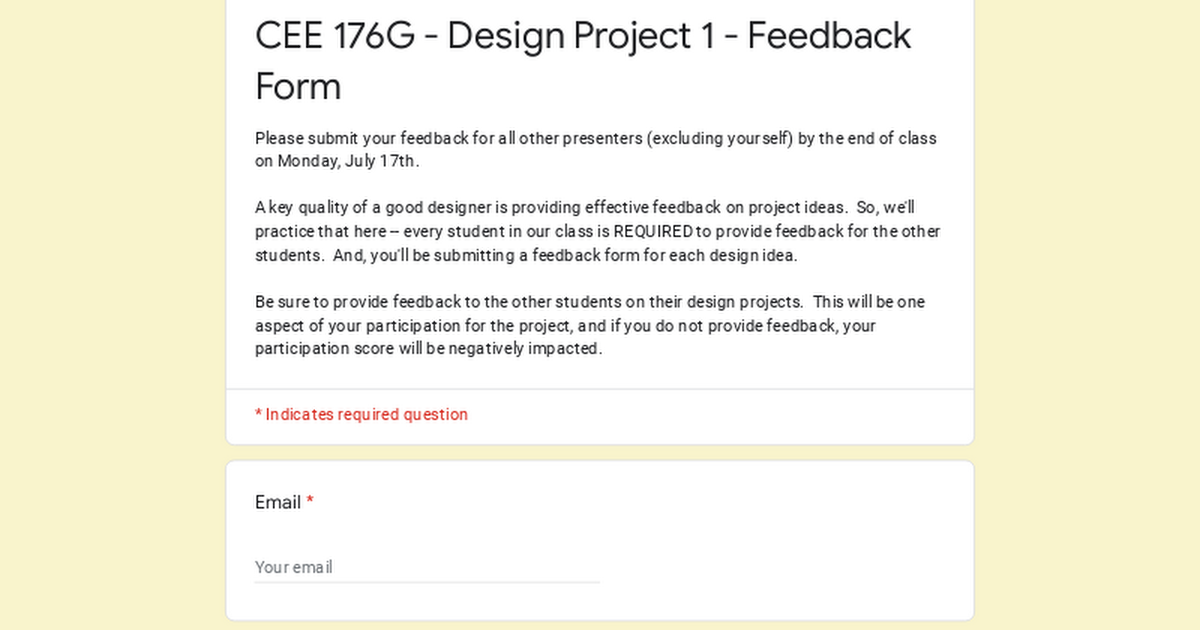
  • CEE 176G - Design Project 1 - Feedback Form

    Please submit your feedback for all other teams (excluding your own) by Wed, July 19 at 10am. A key quality of a good designer is providing effective feedback on project ideas. So, we'll practice that here -- every student in our class is REQUIRED to provide feedback for the other students. And, you'll be submitting a feedback form for each design idea. Be sure to provide feedback to the other students on their design projects. This will be one aspect of your final score for the project. If you do not provide feedback, your final score will be negatively impacted.

    forms.gle

    CEE 176G - Design Project 1 - Feedback Form
    image
‣

Class Session 8 | Wed, July 19 - Design Project 2 Kickoff - Pivot time!

‣
Pitch Session Results
‣
General Feedback
  • Creativity & Originality High. Even two projects in same area were pitched differently.
  • Persuasiveness/Impact (Sustainability, Usability, Feasibility, Gain, Positivity, Grab, The Team, Promise & Ask…)
  • Evidence of Design Thinking (CCP, POV, Humans,…)
  • Timing, Visuals & Scripts
  • A reminder about Stanford Honor Code. ChatGPT. Plagiarism.
‣
Polling Results
docs.google.com

docs.google.com

‣
What’s Next - Publishing Your Ideas
‣
One Page Spec Sheet / Summaries for DezignBläst Studio Publication
Sustainability Design Thinking Design Project 1 Template

Product* Name Designer Name (ie, your name) Design Date (eg, Friday, July 17, 2023) CONCEPT (Short paragraph <100 words) 3 MAIN FEATURES (<10 words each) Feature 1 Feature 2 Feature 3 KEY BENEFITS Benefit 1 Benefit 2 Benefit 3 PROBLEM STATEMENT … CHARACTER PROFILE … POV STATEMENT … P...

docs.google.com

Sustainability Design Thinking Design Project 1 Template

Due by 9:00 AM Saturday July 22, 2023.

  • ANNOUNCEMENT: Publication Editorial committee opportunity: optional & voluntary; selection process
‣
Design Project 2 Prompt
Design Project 2 | Project BriefDesign Project 2 | Project Brief
‣
Designing to Affect Behavior in a Very Different Way
  • Larger scale — community vs. individual
  • Different medium — physical
‣
Project Design Idea Requirements
  • Must be Built Environment feature (space) or physical intervention
  • Focus not a service or policy - but could be technology integrated into space/structure.
  • Each team picks a domain, but no domain can have more than 2 teams. You will have 5 minutes to discuss & decide.
‣
Principal Focus / Domain Choices
  • Educational
  • Recreational
  • Health (treatment, rehabilitation, services)
  • Travel/Transportation
  • Living (and Sleeping)
  • Energy (maybe inspired by CEF)
  • Food & Agriculture (maybe inspired by Stanford Farm)
  • Environmental (quality, waste, remediation, resource management, restoration, preservation, etc)
  • Tourism/Exhibit/Destination
  • Shopping & Dining
‣
Teamwork & Teambuilding Exercise
Hand Squeeze Teamwork Teambuilding Exercise

IDEA “Communicate a message through line of team members.” PURPOSE To balance messaging Speed & accuracy in a team collaboration setting. SET-UP 1 Two teams stand in line facing each other. Check for pairing. Face-to-Face. SET-UP 2 Set up hand-holding. Sense number of squeezes. Pass it down the l...

docs.google.com

Hand Squeeze Teamwork Teambuilding Exercise
  • Stanford Quad — Sustainability by Necessity
‣
Forming Project 2 Design Teams
  • 11 teams of 4 students each
  • Formation Options
  • ‣
    Team Captains
    • Theo Aronson
    • Felipe Goes
    • Shambhavi Gupta
    • Alexander Jayasuria
    • Kevin Haller
    • Isabelle Mak
    • Karim Mallak
    • Adeesh Rathod
    • Pawandeep Sekhon
    • Hoshita Undella
    • Melanie Wang
    ‣
    Random Hat
‣
✎ Enter Your Team Members for Each Team Code (one person per team)

Project 2 Teams | Summer 2023

Team Code
Team Name
Team Members
Domain / Focus Area
Community
Team Journal Entries
🏬
Alpha

All Star by Smash Mouth

Gorbacheva, AnnaAlshamsi, AblaKheraj, IlyanJayasuria, Alexander

Shopping & Dining

🧳Design Project 2 | Mini Proposals (Shopping & Dining)🧥Design Project 2 | Documenting the Design Process🏑Design Project 2 | Team Work Plans🎃Design Project 2 | Sketches & Prototyping
B(ravo)

Junior Varsity

Haller, KevinHorder, MasonYepez, Sean Lee, Eugenie

Food & Agriculture, Energy

🥬Design Project 2 | Mini ProposalsDesign Project 2 | Team Work Plan7/26 Outside Class Notes | Examples of Food Hubs & Food AidDesign Project 2 | 7/26 Class Notes7/26 Class Notes | Group Team-builderDesign Project 2 | Interview #1: Dr. RamírezDesign Project 2 | Interview #2: Franck AmatoDesign Project 2 | Interview #3: Che HorderDesign Project 2 | Interview #4: Jessie Shim7/28 Office Hours with Glenn KatzDesign Project 2 | Testing Session 1Design Project 2 | Plan for Iterating #1Design Project 2 | Interview SummaryDesign Project 2 | Composite CharactersDesign Project 2 | POV StatementsDesign Project 2 | MVP DefinitionDesign Project 2 | HMW Divergent/ConvergentDesign Project 2 | Prototype WIPDesign Project 2 | Testing Session 1Design Project 2 | Plan for Sharing Design Project 2 | Mini Proposals
🏙️
C(haCha)

The Fantastic Four

Undella, HoshitaMullee, ThomasLengo, AviadZoumpoulis, Georgios

Recreation, Health

🌏Design Project 2 | Mini ProposalsDesign Project 2 | Team Work Plans - Team CProject 2 - Interviews (Team C - The Fantastic Four)Divergent Thinking (How Might We?)Team C - Composite Character ProfilesTeam C - POV StatementsTeam C - Minimum Viable Product DefinitionsConvergent Thinking (Select Specific Features)Narrow Down to Specific Ideas (Max 3)Team C - Interview AnalysisTeam C - 4-minute sketching/drawing exerciseCompile List of Needs & IdeasTeam C - Prototype Sketches (1st IterationTeam C - First Testing Session FeedbackChanges Made after Testing Session 1Team C - Testing Session 2 FeedbackKey Elements to Include in Presentation Based on Class SessionDesign Project 2 | NarationDesign Project 2 | Mini Proposals2D & 3D DesignsDesign Project 2 | Recorded Pitch VideoDesign Project 2 | Competitive AnalysisDesign Project 2 | Sustainability, Feasibility, and Human Centric AnalysisDesign Project 2 | Spec SheetDesign Project 2 | Office Hours with Colin & Glenn (8/4)
D(elta)

D-Amazin Ones

Sekhon, PawandeepVergari, VittorioYang, Ziyan (Chelsea)Iller, Samuel

Health and education

Students

Design Project 2 | Mini ProposalsDesign Project 2 | Team Work PlansDesign Project 2 | Composite Character Profiles Design Project 2 | Interviews & Key Findings Design Project 2 | Prototyping PlanDesign Project 2 | POV StatementsDesign Project 2 | MVPFeedback notesDesign Project 2 | Testing Session 1Design Project 2 | Plan For IteratingTesting Session 2Design Project 2 | Divergent thinking - How might we…?Design Project 2 | Convergent Thinking - Feature SelectionDesign Project 2 | Spec SheetDesign Project 2 | Sustainability AnalysisDesign Project 2 | Competitive AnalysisFeedback notesRecorded Project Pitches Submission
E(cho)

Powerpuffs (GREENSTOP)

Wang, Yijing (Melanie)Matsumoto, SatoshiAlharthi, ShayaFarahani, Delara

Tourism transportation around Stanford

Tourists at Stanford University

Design Project 2 | Mini ProposalsDesign Project 2 | Team Work PlansDesign Project 2 | Composite Character ProfileDesign Project 2 | Interview Design Project 2 | POV StatementsDesign Project 2 | MVP + Divergent/Convergent ThinkingDesign Project 2 | Prototyping planDesign Project 2 | Prototype WIPDesign Project 2 | Testing Session 1Design Project 2 | IteratingDesign Project 2 | Testing Session 2Design Project 2 | Sharing (Script)Design Project 2 | Divergent-Convergent Thinking (How Might We…?)Design Project 2 | Sustainability AnalysisDesign Project 2 | Competitive AnalysisDesign Project 2 | Final Sharing (YT Video, Spect Sheet etc.)Design Project 2 | Final Sketches
F(oxtrot)

Guardians of Sustainability

Andria, DenisAhmed, KhaledSatubaldiyeva, DilnazCarvalho Goes, Felipe

Systems — living, Environmental → Refugee crisis

NGO operators

Design Project 2 | Mini ProposalsDesign Project 2 | Team Work Plans
🫒
G(amma)

The Great Gardeners

Rathod, AdeeshGovil, MaanyaRamos, JessicaRubino, Alessandro A.L.

Food & Agriculture, Environmental

Design Project 2 | Mini Proposals Design Project 2 | Team Work PlanDesign Project 2 | Testing Session 2Design Project 2 | InterviewsDesign Project 2 | Composite CharactersDesign Project 2 | POV StatementsDesign Project 2 | HMWDesign Project 2 | Prototyping planDesign Project 2 | Prototype WIPDesign Project 2 | MVP DefinitionDesign Project 2 | Plan for IteratingDesign Project 2 | Sustainability analysisDesign Project 2 | Project 2 - SharingDesign Project 2 | Competitive AnalysisDesign Project 2 | Final SketchesDesign Project 2 | Prototyping and Testing SummaryDesign Project 2 | Testing Session 1
⚡
H(ipHop)

Quadruple Force

Mallak, KarimNakornchai, Peerapat (Will)Jones, IsabelleChandra, Satyan

Travel/Transportation

Design Project 2 | Mini Proposals + IdeatingDesign Project 2 | InterviewsWork PlanDesign Project 2 | MVPDesign Project 2 | Composite CharacterDesign SketchesDesign Project 2 | POV and ProblemDesign Project 2 | Feedback 1Design Project 2 | Team DeckDesign Project 2 | Plan for IteratingDesign Project 2 | Finalized Prototype 1Design Project 2 | How Might We?Design Project 2 | Feedback Round 2Design Project 2 | Prototyping and Testing SummaryDesign Project 2 | Sustainability AnalysisDesign Project 2 | Competitive AnalysisImages of Final PrototypeYouTube LinkDesign Project 2 | Draft of Spec Sheet
(I)nSpire

Team i - ( I )nspire

Riordan, ThomasHule Patil, AbhaysinhAhmad, HishamAronson, Theo

Education & Wellness

🏢Design Project 2 | Mini Proposals (Indigo) Design Project 2 | Team Work PlansDesign Project 2 | InterviewsDesign Project 2 | Office Hours Mtg NotesDesign Project 2 | Composite Character ProfilesDesign Project 2 | POV StatementsDesign Project 2 | MVPDesign Project 2 | PrototypingDesign Project 2 | Testing Notes (Day 1)Design Project 2 | Divergent Thinking (How might we…?) + Convergent Thinking (Concept Features)New sketch + Convergent ideasDesign Project 2 | Testing Notes (Day 2)Design Project 2 | Video Pitch ScriptDesign Project 2 | MVP 2.0Design Project 2 | Presentation & VideoDesign Project 2 | Spec SheetDesign Project 2 | Modular Nodule Sketches & Main Building Design SliceDesign Project 2 | SketchUp 2D Main Building ExplorationDesign Project 2 | Competitive AnalysisDesign Project 2 | Sustainability Analysis
J(azzy)

HIJAZ

Mak, IsabelleAngela YeHuang, HarrySuzan, Zeynep

Shopping & Dining

Design Project 2 | Mini ProposalsDesign Project 2 | Team Work PlansDesign Project 2 | Interview ResultsDesign Project 2 | Composite CharactersDesign Project 2 | POV Statements Design Project 2 | MVP DefinitionDesign Project 2 | Preliminary features brainstormDesign Project 2 | Sustainability analysisDesign Project 2 | Competitive analysisDesign Project 2 | Prototyping and feedbackDesign Project 2 | PresentationDesign Project 2 | Spec Sheet
🖼️
UpsyK

Team UpsyK 😎

🐨Gupta, ShambhaviMart Cunha Xavier Ferreira, ManuelBhandari, TrishlaHe, Xizhu (Siena)

Recreational

♠️Design Project 2 | Mini Proposals🪄Design Project 2 | Team Work PlansDesign Project 2 | Team Design JournalDesign Project 2 | Feedback from iteration round 1Design Project 2 | Round 2 Testing & feedback🪐Design Project 2 | Sustainability Analysis🎯Design Project 2 | Competitive Analysis
‣
Ideating about Team Focus
‣
Principal Focus / Domain

Choices

  • Educational
  • Recreational
  • Health (treatment, rehabilitation, services)
  • Travel/Transportation
  • Living (and Sleeping)
  • Energy (maybe inspired by CEF)
  • Food & Agriculture (maybe inspired by Stanford Farm)
  • Environmental (quality, waste, remediation, resource management, restoration, preservation, etc)
  • Tourism/Exhibit/Destination
  • Shopping/Dining
‣
Project Design Idea Requirements
  • Must be Built Environment feature (space) or physical intervention
  • Focus cannot be a service, policy or legally-based
  • Technologies are OK - but must be integrated into a space/structure.
  • Pick a Domain | 5 minutes
    • Each team picks a domain, but no domain can have more than 2 teams.
    • You will have 5 minutes to discuss & decide.
‣
✎ Enter Your Team’s Principal Focus

Project 2 Teams | Summer 2023

Team Code
Team Name
Team Members
Domain / Focus Area
Community
Team Journal Entries
🏬
Alpha

All Star by Smash Mouth

Gorbacheva, AnnaAlshamsi, AblaKheraj, IlyanJayasuria, Alexander

Shopping & Dining

🧳Design Project 2 | Mini Proposals (Shopping & Dining)🧥Design Project 2 | Documenting the Design Process🏑Design Project 2 | Team Work Plans🎃Design Project 2 | Sketches & Prototyping
B(ravo)

Junior Varsity

Haller, KevinHorder, MasonYepez, Sean Lee, Eugenie

Food & Agriculture, Energy

🥬Design Project 2 | Mini ProposalsDesign Project 2 | Team Work Plan7/26 Outside Class Notes | Examples of Food Hubs & Food AidDesign Project 2 | 7/26 Class Notes7/26 Class Notes | Group Team-builderDesign Project 2 | Interview #1: Dr. RamírezDesign Project 2 | Interview #2: Franck AmatoDesign Project 2 | Interview #3: Che HorderDesign Project 2 | Interview #4: Jessie Shim7/28 Office Hours with Glenn KatzDesign Project 2 | Testing Session 1Design Project 2 | Plan for Iterating #1Design Project 2 | Interview SummaryDesign Project 2 | Composite CharactersDesign Project 2 | POV StatementsDesign Project 2 | MVP DefinitionDesign Project 2 | HMW Divergent/ConvergentDesign Project 2 | Prototype WIPDesign Project 2 | Testing Session 1Design Project 2 | Plan for Sharing Design Project 2 | Mini Proposals
🏙️
C(haCha)

The Fantastic Four

Undella, HoshitaMullee, ThomasLengo, AviadZoumpoulis, Georgios

Recreation, Health

🌏Design Project 2 | Mini ProposalsDesign Project 2 | Team Work Plans - Team CProject 2 - Interviews (Team C - The Fantastic Four)Divergent Thinking (How Might We?)Team C - Composite Character ProfilesTeam C - POV StatementsTeam C - Minimum Viable Product DefinitionsConvergent Thinking (Select Specific Features)Narrow Down to Specific Ideas (Max 3)Team C - Interview AnalysisTeam C - 4-minute sketching/drawing exerciseCompile List of Needs & IdeasTeam C - Prototype Sketches (1st IterationTeam C - First Testing Session FeedbackChanges Made after Testing Session 1Team C - Testing Session 2 FeedbackKey Elements to Include in Presentation Based on Class SessionDesign Project 2 | NarationDesign Project 2 | Mini Proposals2D & 3D DesignsDesign Project 2 | Recorded Pitch VideoDesign Project 2 | Competitive AnalysisDesign Project 2 | Sustainability, Feasibility, and Human Centric AnalysisDesign Project 2 | Spec SheetDesign Project 2 | Office Hours with Colin & Glenn (8/4)
D(elta)

D-Amazin Ones

Sekhon, PawandeepVergari, VittorioYang, Ziyan (Chelsea)Iller, Samuel

Health and education

Students

Design Project 2 | Mini ProposalsDesign Project 2 | Team Work PlansDesign Project 2 | Composite Character Profiles Design Project 2 | Interviews & Key Findings Design Project 2 | Prototyping PlanDesign Project 2 | POV StatementsDesign Project 2 | MVPFeedback notesDesign Project 2 | Testing Session 1Design Project 2 | Plan For IteratingTesting Session 2Design Project 2 | Divergent thinking - How might we…?Design Project 2 | Convergent Thinking - Feature SelectionDesign Project 2 | Spec SheetDesign Project 2 | Sustainability AnalysisDesign Project 2 | Competitive AnalysisFeedback notesRecorded Project Pitches Submission
E(cho)

Powerpuffs (GREENSTOP)

Wang, Yijing (Melanie)Matsumoto, SatoshiAlharthi, ShayaFarahani, Delara

Tourism transportation around Stanford

Tourists at Stanford University

Design Project 2 | Mini ProposalsDesign Project 2 | Team Work PlansDesign Project 2 | Composite Character ProfileDesign Project 2 | Interview Design Project 2 | POV StatementsDesign Project 2 | MVP + Divergent/Convergent ThinkingDesign Project 2 | Prototyping planDesign Project 2 | Prototype WIPDesign Project 2 | Testing Session 1Design Project 2 | IteratingDesign Project 2 | Testing Session 2Design Project 2 | Sharing (Script)Design Project 2 | Divergent-Convergent Thinking (How Might We…?)Design Project 2 | Sustainability AnalysisDesign Project 2 | Competitive AnalysisDesign Project 2 | Final Sharing (YT Video, Spect Sheet etc.)Design Project 2 | Final Sketches
F(oxtrot)

Guardians of Sustainability

Andria, DenisAhmed, KhaledSatubaldiyeva, DilnazCarvalho Goes, Felipe

Systems — living, Environmental → Refugee crisis

NGO operators

Design Project 2 | Mini ProposalsDesign Project 2 | Team Work Plans
🫒
G(amma)

The Great Gardeners

Rathod, AdeeshGovil, MaanyaRamos, JessicaRubino, Alessandro A.L.

Food & Agriculture, Environmental

Design Project 2 | Mini Proposals Design Project 2 | Team Work PlanDesign Project 2 | Testing Session 2Design Project 2 | InterviewsDesign Project 2 | Composite CharactersDesign Project 2 | POV StatementsDesign Project 2 | HMWDesign Project 2 | Prototyping planDesign Project 2 | Prototype WIPDesign Project 2 | MVP DefinitionDesign Project 2 | Plan for IteratingDesign Project 2 | Sustainability analysisDesign Project 2 | Project 2 - SharingDesign Project 2 | Competitive AnalysisDesign Project 2 | Final SketchesDesign Project 2 | Prototyping and Testing SummaryDesign Project 2 | Testing Session 1
⚡
H(ipHop)

Quadruple Force

Mallak, KarimNakornchai, Peerapat (Will)Jones, IsabelleChandra, Satyan

Travel/Transportation

Design Project 2 | Mini Proposals + IdeatingDesign Project 2 | InterviewsWork PlanDesign Project 2 | MVPDesign Project 2 | Composite CharacterDesign SketchesDesign Project 2 | POV and ProblemDesign Project 2 | Feedback 1Design Project 2 | Team DeckDesign Project 2 | Plan for IteratingDesign Project 2 | Finalized Prototype 1Design Project 2 | How Might We?Design Project 2 | Feedback Round 2Design Project 2 | Prototyping and Testing SummaryDesign Project 2 | Sustainability AnalysisDesign Project 2 | Competitive AnalysisImages of Final PrototypeYouTube LinkDesign Project 2 | Draft of Spec Sheet
(I)nSpire

Team i - ( I )nspire

Riordan, ThomasHule Patil, AbhaysinhAhmad, HishamAronson, Theo

Education & Wellness

🏢Design Project 2 | Mini Proposals (Indigo) Design Project 2 | Team Work PlansDesign Project 2 | InterviewsDesign Project 2 | Office Hours Mtg NotesDesign Project 2 | Composite Character ProfilesDesign Project 2 | POV StatementsDesign Project 2 | MVPDesign Project 2 | PrototypingDesign Project 2 | Testing Notes (Day 1)Design Project 2 | Divergent Thinking (How might we…?) + Convergent Thinking (Concept Features)New sketch + Convergent ideasDesign Project 2 | Testing Notes (Day 2)Design Project 2 | Video Pitch ScriptDesign Project 2 | MVP 2.0Design Project 2 | Presentation & VideoDesign Project 2 | Spec SheetDesign Project 2 | Modular Nodule Sketches & Main Building Design SliceDesign Project 2 | SketchUp 2D Main Building ExplorationDesign Project 2 | Competitive AnalysisDesign Project 2 | Sustainability Analysis
J(azzy)

HIJAZ

Mak, IsabelleAngela YeHuang, HarrySuzan, Zeynep

Shopping & Dining

Design Project 2 | Mini ProposalsDesign Project 2 | Team Work PlansDesign Project 2 | Interview ResultsDesign Project 2 | Composite CharactersDesign Project 2 | POV Statements Design Project 2 | MVP DefinitionDesign Project 2 | Preliminary features brainstormDesign Project 2 | Sustainability analysisDesign Project 2 | Competitive analysisDesign Project 2 | Prototyping and feedbackDesign Project 2 | PresentationDesign Project 2 | Spec Sheet
🖼️
UpsyK

Team UpsyK 😎

🐨Gupta, ShambhaviMart Cunha Xavier Ferreira, ManuelBhandari, TrishlaHe, Xizhu (Siena)

Recreational

♠️Design Project 2 | Mini Proposals🪄Design Project 2 | Team Work PlansDesign Project 2 | Team Design JournalDesign Project 2 | Feedback from iteration round 1Design Project 2 | Round 2 Testing & feedback🪐Design Project 2 | Sustainability Analysis🎯Design Project 2 | Competitive Analysis
‣
1-Paragraph Mini Proposals | Due by EOD Sunday (11:59pm) July 23, 2023
Design Project 2 -  Team Mini ProposalsDesign Project 2 - Team Mini Proposals

Class Session 8 Recording

Panopto

Capture, manage, and search all your video content.

stanford-pilot.hosted.panopto.com

Panopto
‣
1-Paragraph Mini Proposals | Due by EOD Sunday (11:59pm) July 23, 2023
Design Project 2 -  Team Mini ProposalsDesign Project 2 - Team Mini Proposals
‣

Class Session 9 | Mon, July 24 - Design Project 2 - Mini-Proposals & Team Planning

💡
Announcement: Stanford Environmental Engineering Lab Tour — Monday July 31, 2023, 1:00 pm - 2:00 pm. Meet at basement level of blue atrium in Y2E2.
‣
Project 1 Grading
‣
Part 1 - Peer Grading
image
‣
Part 2 - Teaching Team Grading
image
‣
Project 2 Mini-Proposals
‣
Examples of Using Design Thinking to Transform User Experiences
  • Airport Concourses
  • School Cafeteria
  • Studio Feedback / Ideating on Team Mini-Proposals
‣
Project 2 Team Planning
‣
Week 5 Deliverables
‣
1. Developing a Team Work Plan | Due - Wednesday, Jul 26 at 4:30 PM
Design Project 2 -  Team Work PlansDesign Project 2 - Team Work Plans
‣
Map Out your Team’s Plan for the Week
  • What tasks will your team complete to create the required deliverables?
  • Which team member will complete each task?
  • All work submitted represents the TEAM and will be evaluated for a TEAM score
‣
How many hours should our team be spending outside of class?
  • Team of 4 students
  • 3 units x 3.75 hours per week (outside of class) = 11.25 hours per week per student
  • Team expectation = 45 hours per week (outside of class)
‣
2. Document Your Design Process in your Team Design Journal | Due - Sunday, Jul 30 at 11:59 PM
  • Empathizing
    • Survey, Interviews, or Observations
    • Composite Character Profiles;
  • Defining
    • POV Statements
    • Minimum Viable Product Definitions
  • Ideating
    • Divergent Thinking — How might we…?
    • Convergent Thinking — Feature selection…
‣
3. Prototyping | Due - Monday, Jul 31 at start of class session
  • Bring initial prototypes of your design idea to share and test in class in whatever form works best for you.
    • Design sketches
      • Must be your own sketches
      • No AI generated images
    • Physical models — cardboard, foam core, Lego, or…
    • Digital models — SketchUp, Revit, Minecraft, Sims, or…

Class Session 9 Recording

Panopto

Capture, manage, and search all your video content.

stanford-pilot.hosted.panopto.com

Panopto
‣

Class Session 10 | Wed, July 26 - Design Project 2 - Team Work Day

💡
Announcement: Stanford Environmental Engineering Lab Tour — Monday July 31, 2023, 1:00 pm - 2:00 pm. Meet at basement level of blue atrium in Y2E2.
‣
Building Team Work Plans / Blueprints for Success | Due - Wednesday, Jul 26 at 2:00 PM
‣
Map Out your Team’s Plan for the Week
  • What tasks will your team complete to create the required deliverables?
  • Which team member will complete each task?
‣
TIPS for Your Team Work Plan
  • Choose a captain / project manager
‣
Work as an Effective Team
‣
DON’T set up serial tasks
  • Interviewing/surveying —> Alice
  • Character Composite Profiles —> Betty
  • POV Statements —> Carl
  • MVP —> David
‣
DO work together to advance the design between steps
  • Individual team members can lead the work on specific tasks
  • ALL TEAM MEMBERS should collaborate to review the results and decide collectively how to move on to the next step
‣
Be SPECIFIC about Tasks and Expectations — Be sure to assign:
  • Who’s going to do each task
  • When are they going to have it ready
  • An estimated time that you’re willing to commit to each task
    • Set a target time budget for each task
    • Your plan should include about 12 hours per team member each week
    • ‣
      How many hours should we be spending outside of class?
      • Team of 4 students
      • 3 units x 3.75 hours per week (outside of class) = 11.25 hours per week per student
      • Team expectation = 45 hours per week (outside of class)
‣
Don’t skip the Design Thinking steps
  • Have you already decided on the project features? If so, you’re not using Design Thinking…
  • Don’t reverse engineer a fictitious need
Design Project 2 -  Team Work PlansDesign Project 2 - Team Work Plans
‣
Who am I? In the Present Exercise…Physical, Mental, Spiritual & More!
Who am I? In the Present Exercise

IDEA Meditative blank-slate technique to scoop the first thoughts that come to mind when asking “Who am i?” PURPOSE To find ideas for Design Project 2 that have personal connection. SET-UP Sit comfortably. Close eyes. STEPS Listen. Feel. Clear. Who am I? ASPECTS Physical Mental Spiritual Interest...

docs.google.com

Who am I? In the Present Exercise
‣
Project 2 Team Work — Week 5 Deliverables
  • Document Your Design Process in your Team Design Journal | Due - Sunday, Jul 30 at 11:59 PM
    • Empathizing
      • Survey, Interviews, or Observations
      • Composite Character Profiles
    • Defining
      • POV Statements
      • Minimum Viable Product Definitions
    • Ideating
      • Divergent Thinking — How might we…?
      • Convergent Thinking — Feature selection…
‣
Preparing for Week 6 — Prototyping | Due - Monday, Jul 31 at start of class session
  • Bring initial prototypes of your design idea to share and test in class in whatever form works best for you.
    • Design sketches
      • Must be your own sketches
      • No AI generated images
    • Physical models — cardboard, foam core, Lego, or…
    • Digital models — SketchUp, Revit, Minecraft, Sims, or…
‣

Class Session 11 | Mon, July 31 - Design Project 2 - Testing & Iterating

💡
Announcement: Stanford Environmental Engineering Lab Tour Monday July 31, 2023, 1:00 pm - 2:00 pm. Meet at basement level of blue atrium in Y2E2.
‣
Announcement re: Class Publication

Inclusion of individual Design Project 1 Spec Sheets in the class publication will be optional per the Spec Sheet author’s choosing. If you wish to have your Design Project 1 Spec Sheet included in the publication, a shared Google Drive folder will be created where your contribution can be uploaded. Spec Sheets will be reviewed by the “Spec Sheet Looks Good” members of the editorial committee. These committee members may require formatting changes to fit the publication design. The author may edit/revise textual and graphics content. Uploading of your Spec Sheet to the shared folder will be considered your consent to have your Spec Sheet included in the publication.

‣
Design Project 2: Testing Sessions | 2:40pm — 3:25 pm
  • Format
    • 2 team members stay at table and test the ideas
    • 2 other team members go to other tables to provide feedback
      • 1 goes clockwise
      • 1 goes counterclockwise
‣
Sustainability in the Built Environment | 3:40pm — 3:55 pm
‣
Mindmap
‣
Encouraging Sustainability thru all Phases
  • Design
  • Construction
  • Use
  • De-Commissioning / Re-Use
  • Impact of Buildings on Energy Use
‣
Big Strategies
  • Reduce Energy Use
    • Greater Efficiency
    • Passive Design Strategies
  • Grow use of Renewables
‣
Y2E2 Building at Stanford
www.hpbmagazine.org

www.hpbmagazine.org

‣
Design Project 2: Team Work Session | 3:50pm — 4:20 pm
‣
Week 6 Deliverables | Due - Sunday, Aug 6 at 11:59 PM
  • Team Design Journal Postings
  • Final Design Drawings / Models
  • Recorded Project Pitches
‣
Team Design Project 2 Spec Sheet (Draft copy)
Sustainability Design Thinking Design Project 2 Template

Product* Name [Draft, not final] [Designer Names, alphabetical by last name] [Designer Team Name] [Design Date, eg, Friday, July 17, 2023] CONCEPT (Short paragraph <100 words) … … 3 MAIN FEATURES (<10 words each) Feature 1 Feature 2 Feature 3 KEY BENEFITS Benefit 1 Benefit 2 Benefit 3 (opt...

docs.google.com

Sustainability Design Thinking Design Project 2 Template

Final copy of Design Project 2 Spec Sheet due Wednesday August 9 at 10:00 AM

‣

Class Session 12 | Wed, Aug 2 - Design Project 2 - Test, Iteration, Sharing

‣
Announcements
  • Class Publication
    1. ‣
      Team Design Project 2 Spec Sheet | Draft on Sunday at 11:59pm | Final Due on Tues or Wed
      Sustainability Design Thinking Design Project 2 Template

      Product* Name [Draft, not final] [Designer Names, alphabetical by last name] [Designer Team Name] [Design Date, eg, Friday, July 17, 2023] CONCEPT (Short paragraph <100 words) … … 3 MAIN FEATURES (<10 words each) Feature 1 Feature 2 Feature 3 KEY BENEFITS Benefit 1 Benefit 2 Benefit 3 (opt...

      docs.google.com

      Sustainability Design Thinking Design Project 2 Template
    2. Drop to Canvas
  • Check your Design Journals for Completeness
‣
Design Project 2: Testing Sessions | 2:45pm — 3:25 pm
  • Make sure your prototypes and testing feedback are included in your Design Journal
    • Evaluated on
      • Completeness — document all the design thinking steps
      • Quality
  • Format
    • 2 team members stay at table and test the ideas
    • 2 other team members go to other tables to provide feedback
      • 1 goes clockwise
      • 1 goes counterclockwise
‣
Format for Monday Sharing Session
  • You’re a design team making a proposal to DezignBläst board
    • One INTEGRATED vision
    • Built Form > Sustainable Behaviors
  • Play recording of your 4-minutes pitch / presentation
  • Followed by 4-minute Q&A
    • All team members at front of room
    • Address the questions as a team
‣
Key elements to include 4-minute presentation (connect the dots — why do we need this?)
  • Title Slide / Team Name
  • User Needs Statement / POV
  • Essential Features of Final Design Proposed
    • Image
    • Text
  • Sustainability Analysis
  • Competitive Analysis
‣
Specific Deliverables | Due - Sunday, Aug 6 at 11:59 PM
‣
Team Design Journal Postings
  • Detailed Pages in Notion
    1. User Needs / Interviews Summaries
    2. POV statements
    3. Minimum Viable / Essential Design Features
      • Physical
      • Financial
    4. Prototyping & Testing Summary
      • Images
      • Evolution
    5. Sustainability Analysis
      • How does this design affect sustainable behaviors (human-centric perspective)?
    6. Competitive Analysis
      • Promise & Ask
  • High-Level Summary (Spec Sheet PDF)
    • Draft of Design Project 2 Spec Sheet (upload or link your PDF in Notion)
  • Final Design Images / Models
  • Recorded Project Pitches
    • Upload your recorded project pitch to YouTube
    • Create an UNLISTED link and copy it
    • Embed your YouTube link in your Team’s Design Journal
‣
Revit Workshop > After Class at 4:40pm in Y2E2 184
‣

Class Session 13 | Mon, Aug 7 - Design Project 2 - Sharing / Evaluating & Pivot time

‣
Design Project 2 Pitches — Q&A / Evaluation | Monday, Aug 7 - During Class Session

Team Presentations Order:

  • Team J - HIJAZ | 2:30 - 2:38
  • Team G - The Great Gardeners | 2:39 - 2:47
  • Team D - D-Amazing Ones | 2:48 - 2:56
  • Team K - Team UpsyK | 2:57 - 3:05
  • Team F - Guardians of Sustainability | 3:06 - 3:14
  • Break
  • Team A - All Star | 3:20 - 3:28
  • Team C - The Fantastic Four | 3:29 - 3:37
  • Team I - (I)nspire | 3:38 - 3:46
  • Team B - Junior Varsity | 3:47 - 3:55
  • Team H - Quadruple Force | 3:56 - 4:04
  • Team E - Powerpuffs (GREENSTOP) | 4:05 - 4:13
‣
Project Evaluation Forms
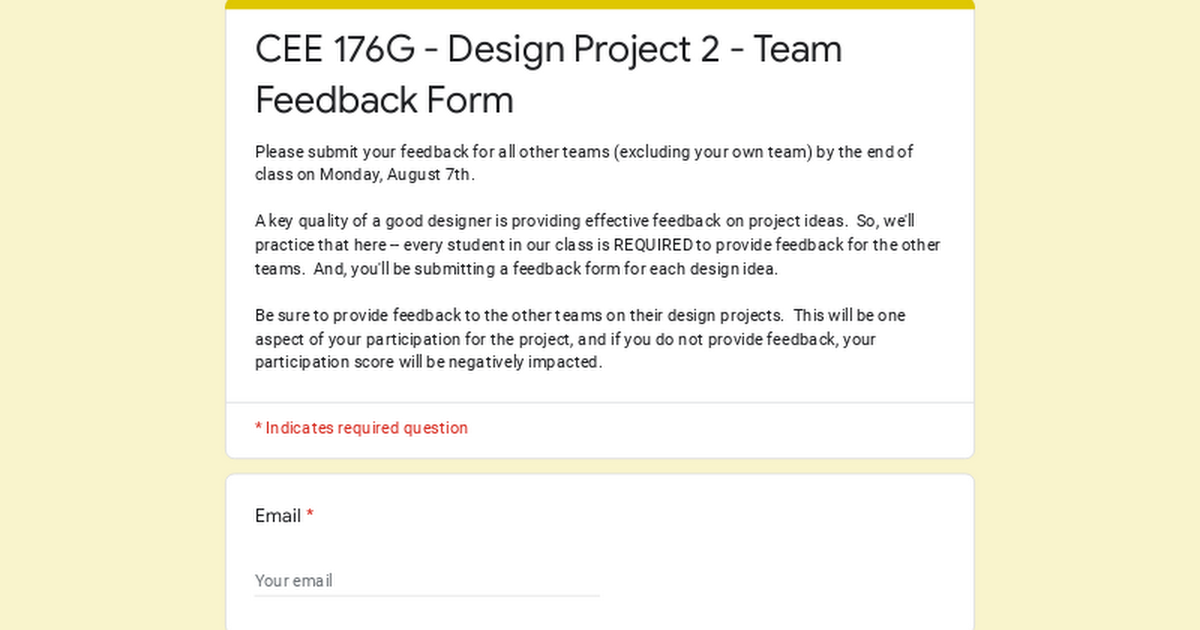
CEE 176G - Design Project 2 - Team Feedback Form

Please submit your feedback for all other teams (excluding your own team) by the end of class on Monday, August 7th. A key quality of a good designer is providing effective feedback on project ideas. So, we'll practice that here -- every student in our class is REQUIRED to provide feedback for the other teams. And, you'll be submitting a feedback form for each design idea. Be sure to provide feedback to the other teams on their design projects. This will be one aspect of your participation for the project, and if you do not provide feedback, your participation score will be negatively impacted.

forms.gle

CEE 176G - Design Project 2 - Team Feedback Form
image
‣
Peer Evaluation Forms
CEE 176G/276G - Design Project 2 - Peer Evaluation Form

Please help us evaluate the participation of your design team members in developing your product idea!

forms.gle

CEE 176G/276G - Design Project 2 - Peer Evaluation Form
image
‣
Pivot - Team Selection for Design Project 3 | 4:15 - 4:20
  • Organization
    • Teams of 6-7 students
    • One week quick turnaround
    • Presented at an exhibition event
  • Design Prompt: Micro-Living Environments for 2050
    • 500 square feet or less
    • Where: City / Suburban / Rural
    • Form Options
      • Tall Building (attached)
      • Low Buildings (attached)
      • Community (detached)
      • Standalone
        • On-Grid
        • Off-Grid
‣
Last Chance: Design Project 1 Spec Sheet for Publication (Canvas Upload)

This Canvas Assignment is available until eod today.

‣
Design Project 2 Spec Sheet: Final Copy & for Publication (Canvas Uploads)
  • Due in Canvas 10:00 am Wednesday August 9, 2023 under assignment “Design Project 2 Spec Sheet”
  • If your team wishes to submit for inclusion in publication, due in Canvas 11:59 pm Sunday August 13, 2023 under assignment “Design Project 2 Spec Sheet for Publication”.
‣

Class Session 14 | Wed, Aug 9 - Design Project 3 - Quickstart

‣
Survey QR Code
image
‣
Team Setup
  • Choose a teams of 6 or 7 members
‣
Post Roster to Slack
  • Submit lists in Slack under #design-project-3
  • Create Team Slack channel (format team-dp3-x)
  • Team Name
‣
Project 3 | Team Design Journal Set-up
  • Create a new page for your team
  • Enter team members
  • Add Tasks and Journal Postings to track your process
‣
Project 3 Format / Timeline
  • One week quick turnaround
  • Presented at an exhibition event on Wed, Aug 16th at 2:30 PM
‣
Design Prompt: Sustainable Micro-Housing Spaces for 2050
‣
Housing Unit Features
  • 500 square feet or less (interior)
  • 1 or 2 occupants
  • Spaces to Provide
    • Sleeping
    • Bathing
    • Cooking / Eating
    • Working
    • Relaxing / Entertaining
    • Exterior space (don’t count toward 500 SF)
‣
Where are they Located / Context
  • City
  • Suburban
  • Rural
‣
How are they Aggregated / Form Options
  • Tall Building (attached)
  • Low Buildings (attached)
  • Community (detached)
  • Standalone
‣
How are they Serviced
  • Utilties
    • On-Grid
    • Off-Grid
  • Transportation
  • Form Options
‣
Team Deliverables
  • Poster | Submit PDF by Monday at 11:59 PM
  • Physical Model or Digital Model
  • Diagrams explaining concept at different levels
    • Innovative features in your unit
    • Floor plan of unit
    • Plan of community
    • Diagram of community in larger regional context
‣
Design Project 3 Spec Sheet | Due in Canvas by 6:30 PM Saturday August 19, 2023
Sustainability Design Thinking Design Project 3 Template

Project Name [Designer Names, alphabetical by last name] [Designer Team Name] [Design Date, eg, Friday, July 17, 2023] CONCEPT (Short paragraph <200 words) … … … … 3 MAIN FEATURES (<10 words each) Feature 1 Feature 2 Feature 3 KEY BENEFITS Benefit 1 Benefit 2 Benefit 3 (optional) ...

docs.google.com

Sustainability Design Thinking Design Project 3 Template

Only one team member needs to submit to cover entire team.

This Spec Sheet will be used for inclusion in the class publication.

‣
Share Your Team’s Mini-Proposal | Due TONIGHT at 11:59 PM
  • What is the problem you’ve defined?
    • Who, What, Why, Where, and When? — POV statement
  • What is the focus of your design thinking?
  • Synthesize a SINGLE, UNIFIED vision
  • Share your initial vision through some preliminary sketches (annotated graphics)
    • Where will it be located?
    • What will the form be?
    • What are the key features you’ll be exploring?
‣
Post Your Team’s Work Plan using the Notion Team Work Plan template | Due TONIGHT at 11:59 PM
  • Goals & Objectives
  • Tasks
  • Number of hours
  • Roles & Responsibilities
  • Deliverables
  • Schedule
  • Tool (Optional): Microsoft Project Professional (no-cost through Stanford ESS)
‣
Project Process Cues
  • Inspirational & Motivational: “I want that, I need that!”
  • Empathy: Innovation for Next Generation
  • Competitive & Sustainable
  • Smart. Intelligent. Automation. Convenience. Resilience. Form & Function.
  • Storytelling & You: Human-centered, Human Behavior Change & Human Enlightenment/Empowerment
  • Visualization, Sketches & Models. Interaction. Usability. User-friendliness.
‣

Pick-Me-Up

3 ways good design makes you happy

In this talk from 2003, design critic Don Norman turns his incisive eye toward beauty, fun, pleasure and emotion, as he looks at design that makes people happy. He names the three emotional cues that a well-designed product must hit to succeed.

www.ted.com

3 ways good design makes you happy
‣

Publication & Spec Sheets

‣
Next Publication Committee Meeting

Friday August 11, 2023, 1:30 pm - 2:30 pm. Y2E2 180.

‣
Design Project 2 Spec Sheets for Publication

Due in Canvas by EOD Sunday August 13, 2023.

‣
Anyone accidentally miss the Design Project 1 Spec Sheet for Publication deadline?

What to do? What to do?

‣

Upcoming Events

‣
Lunch Social

Friday August 11, 2023. 12:00 pm - 1:00 pm. Location tbd.

Bring-Your-Own-Lunch.

RSVP in Slack #general.

‣
Office Hours (Weekly Regular)

Friday, August 11, 2023. 1:00 pm - 5:00 pm. Location: Y2E2 184.

‣
Extra Office Hours
  • Monday August 14 ,and Tuesday August 15, 2023. Times and Location tba.
  • Reserved 30-min time slots for teams.
  • More info tba in Slack #design-project-2.
‣

Class Session 15 | Mon, Aug 14 - Design Project 3 - Check-In and Work Day

‣
Answers to Team Questions about Project 3
‣
Living Spaces vs. Community Spaces
  • Living Spaces must be explicitly addressed
  • Community Spaces add to the picture, but do not replace the focus on Living Spaces.
‣
Square Footage
  • Lofted spaces OK up to 50% of the footprint area.
  • Loft spaces must be open on at least one side to the area below.
  • If more than 50%, the loft area must be counted against the 500 SF target.
‣
Asking Questions (a fundamental design thinking skill)

How is your concept enabling sustainable “micro-living” as an [early adopter] occupant’s preferred choice? [WOW! factor]

How is your concept innovative & positioned in the future?

“Nobody has a clue, despite all the expertise that's been on parade for the past four days, what the world will look like in five years' time. And yet, we're meant to be educating them for it. So the unpredictability, I think, is extraordinary.” - Sir Ken Robinson, TED2006

"People don't know what they want until you show it to them.” - Steve Jobs, Business Week, 1998

‣
Your Personal Story Part III: A Message to My Future Self (”homework” instead of in-class)
A Message to My Future Self Exercise

IDEA Write a script. Record a video. Watch in the future. PURPOSE Have a vision. Keep design thinking yourself. Hopes & Dreams. START SCRIPT Hello! My name is [name] I am from [home] and today is [date]. I am [age] years old. This is a message to my future self. IDEAS who i hope to be. what i hop...

docs.google.com

A Message to My Future Self Exercise

*Instead of doing this in class, I will record a video so that you can follow along and do this exercise on your own. It requires “alone time” anyway. Will let you know when the video is posted.

‣

Class Session 16 | Wed, Aug 16 - Wrap Up
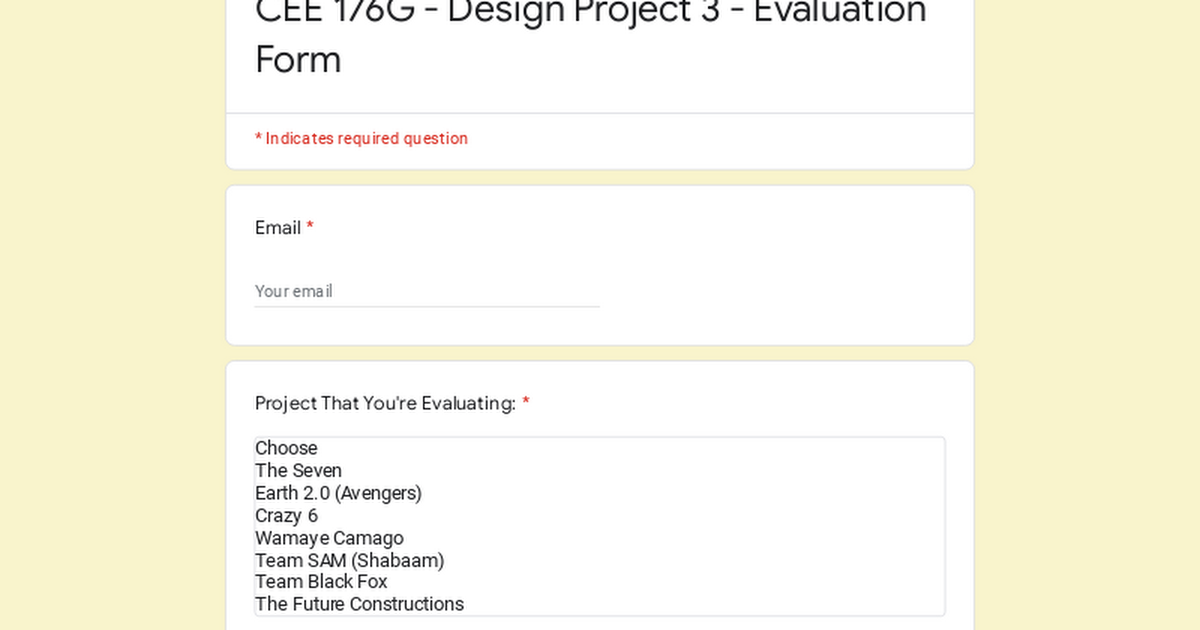
‣
Virtual Poster Stations
‣
Crazy 6
‣
The Future Constructors
‣
Wamaye Camago
‣
Earth 2.0 Avengers
‣
Team Black Fox
Design Project 3 -Black Fox.pdf2454.2KB
‣
Team SAM (Shabaam)
‣
The Seven
‣
Evaluations | 2:40p - 3:30p
‣
Project Evaluations

Link to Form: https://forms.gle/bDE949W3b365x5KEA

CEE 176G - Design Project 3 - Evaluation Form

forms.gle

CEE 176G - Design Project 3 - Evaluation Form
image
‣
Team Peer Evaluations
  • Share 100 points (total of all points awarded should be 100)
  • Link to Form: https://forms.gle/511VUybRLW7FxTS46
CEE 176G/276G - Design Project 3 - Peer Evaluation Form

Please help us evaluate the participation of your design team members in developing your product idea!

forms.gle

CEE 176G/276G - Design Project 3 - Peer Evaluation Form
image
‣
Game time! | 3:35p - 4:10p
Spaghetti Tower Marshmallow Exercise

Spaghetti Tower Marshmallow Exercise ycisl Team. Spaghetti. Tape. Marshmallow. Design-Build.

docs.google.com

Spaghetti Tower Marshmallow Exercise
‣
Designing Your Life | 4:10p - 4:20p
‣
A Message to My Future Self (Video)
A Message to My Future Self

Video for Sustainability Design Thinking Class

youtu.be

A Message to My Future Self
‣
Design Project 3 Spec Sheet | Due in Canvas by 6:30 PM Saturday August 19, 2023
Sustainability Design Thinking Design Project 3 Template

Project Name [Designer Names, alphabetical by last name] [Designer Team Name] [Design Date, eg, Friday, July 17, 2023] CONCEPT (Short paragraph <200 words) … … … … 3 MAIN FEATURES (<10 words each) Feature 1 Feature 2 Feature 3 KEY BENEFITS Benefit 1 Benefit 2 Benefit 3 (optional) ...

docs.google.com

Sustainability Design Thinking Design Project 3 Template

Only one team member needs to submit to cover entire team.

This Spec Sheet will be used for inclusion in the class publication.

‣

Upcoming Classes

‣

Design Project 1 — Promoting Sustainable Behaviors and Practices for INDIVIDUALS

Design Project 1 | Project BriefDesign Project 1 | Project Brief
‣

Design Project 2 — Promoting Sustainable Behaviors and Practices for a COMMUNITY

Design Project 2 | Project BriefDesign Project 2 | Project Brief

Studio Design Journals

You’ll find pages for your Studio Design Journals below…. You’ll use these to record and share your process for each of the design projects.

‣

Project 3 | Team Design Journals

Project 3 Teams | Summer 2023

Team Jay (Example)
Team Jay (Example)
The SevenThe Seven
🌆
The Seven
Earth 2.0 (Avengers : New Age of Ultrons)Earth 2.0 (Avengers : New Age of Ultrons)
🤖
Earth 2.0 (Avengers : New Age of Ultrons)
Crazy 6
Crazy 6
Wamaye CamagoWamaye Camago
🤲
Wamaye Camago
Team SAM
Team SAM
Team Black Fox
Team Black Fox
The Future Constructors
🚧
The Future Constructors
‣

Project 2 | Team Design Journals

Project 2 Teams | Summer 2023

AlphaAlpha
🏬
Alpha

All Star by Smash Mouth

Shopping & Dining

B(ravo)B(ravo)
B(ravo)

Junior Varsity

Food & Agriculture, Energy

C(haCha)C(haCha)
🏙️
C(haCha)

The Fantastic Four

Recreation, Health

D(elta)D(elta)
D(elta)

D-Amazin Ones

Health and education

Students

E(cho)E(cho)
E(cho)

Powerpuffs (GREENSTOP)

Tourism transportation around Stanford

Tourists at Stanford University

F(oxtrot)F(oxtrot)
F(oxtrot)

Guardians of Sustainability

Systems — living, Environmental → Refugee crisis

NGO operators

G(amma)G(amma)
🫒
G(amma)

The Great Gardeners

Food & Agriculture, Environmental

H(ipHop)H(ipHop)
⚡
H(ipHop)

Quadruple Force

Travel/Transportation

(I)nSpire(I)nSpire
(I)nSpire

Team i - ( I )nspire

Education & Wellness

J(azzy)J(azzy)
J(azzy)

HIJAZ

Shopping & Dining

UpsyKUpsyK
🖼️
UpsyK

Team UpsyK 😎

Recreational

‣

Project 1 | Personal Design Journals

CEE 176G/276G Students | Summer 2023

Ahmad, HishamAhmad, Hisham
Ahmad, Hisham
Ahmed, KhaledAhmed, Khaled
Ahmed, Khaled
Alharthi, ShayaAlharthi, Shaya
Alharthi, Shaya
Alshamsi, AblaAlshamsi, Abla
Alshamsi, Abla
Andria, DenisAndria, Denis
Andria, Denis
Aronson, TheoAronson, Theo
Aronson, Theo
Bhandari, TrishlaBhandari, Trishla
Bhandari, Trishla
Carvalho Goes, FelipeCarvalho Goes, Felipe
Carvalho Goes, Felipe
Chandra, SatyanChandra, Satyan
Chandra, Satyan
Farahani, DelaraFarahani, Delara
Farahani, Delara
Gorbacheva, Anna
Gorbacheva, Anna
Govil, MaanyaGovil, Maanya
Govil, Maanya
Gupta, ShambhaviGupta, Shambhavi
🐨
Gupta, Shambhavi
Haller, KevinHaller, Kevin
Haller, Kevin
He, Xizhu (Siena)He, Xizhu (Siena)
He, Xizhu (Siena)
Horder, MasonHorder, Mason
Horder, Mason
Huang, HarryHuang, Harry
Huang, Harry
Hule Patil, AbhaysinhHule Patil, Abhaysinh
Hule Patil, Abhaysinh
Iller, SamuelIller, Samuel
Iller, Samuel
Jayasuria, AlexanderJayasuria, Alexander
Jayasuria, Alexander
Jones, IsabelleJones, Isabelle
Jones, Isabelle
Kheraj, IlyanKheraj, Ilyan
Kheraj, Ilyan
Lee, EugenieLee, Eugenie
Lee, Eugenie
Lengo, AviadLengo, Aviad
Lengo, Aviad
Mak, IsabelleMak, Isabelle
Mak, Isabelle
Mallak, KarimMallak, Karim
Mallak, Karim
Mart Cunha Xavier Ferreira, ManuelMart Cunha Xavier Ferreira, Manuel
Mart Cunha Xavier Ferreira, Manuel
Matsumoto, SatoshiMatsumoto, Satoshi
Matsumoto, Satoshi
Mullee, ThomasMullee, Thomas
Mullee, Thomas
Nakornchai, Peerapat (Will)Nakornchai, Peerapat (Will)
Nakornchai, Peerapat (Will)
Ramos, JessicaRamos, Jessica
Ramos, Jessica
Rathod, AdeeshRathod, Adeesh
Rathod, Adeesh
Riordan, ThomasRiordan, Thomas
Riordan, Thomas
Rubino, Alessandro A.L.Rubino, Alessandro A.L.
Rubino, Alessandro A.L.
Satubaldiyeva, DilnazSatubaldiyeva, Dilnaz
Satubaldiyeva, Dilnaz
Sekhon, PawandeepSekhon, Pawandeep
Sekhon, Pawandeep
Suzan, ZeynepSuzan, Zeynep
Suzan, Zeynep
Undella, HoshitaUndella, Hoshita
Undella, Hoshita
Vergari, VittorioVergari, Vittorio
Vergari, Vittorio
Wang, Yijing (Melanie)Wang, Yijing (Melanie)
Wang, Yijing (Melanie)
Angela YeAngela Ye
Angela Ye
Yang, Ziyan (Chelsea)Yang, Ziyan (Chelsea)
Yang, Ziyan (Chelsea)
Yepez, Sean Yepez, Sean
Yepez, Sean
Zoumpoulis, GeorgiosZoumpoulis, Georgios
Zoumpoulis, Georgios
Student Template
Student Template
Student Template
Student Template
🚫CEE 176G/276G | Summer 2023 — For Teaching Team Use Only — DO NOT EDIT