CO Master Copy Notes
SCHEDULE
MONDAY | WEDNESDAY | |
WEEK 1 | Welcome & Logistics; Warm-up Exercise | DP1: Empathy |
WEEK 2 | DP1: Defining (Problem, PoV, CCP, Role Play) | DP1: Ideating (Solution, Brainstorming) |
WEEK 3 | DP1: Prototyping (Models, Sketches) | DP1: Testing & Iteration |
WEEK 4 | DP1: Communicating | DP1: PRESENTATION |
WEEK 5 | DP2: Kick-off | DP2: Approval Checkpoint & Journey Map |
WEEK 6 | DP2: Design Thinking
Spaghetti Tower-Marshmallow | DP2: Final touches & Freeze
Who am I? Business Card & Satoru Iwata |
WEEK 7 | DP2: PRESENTATION
Cultural Dimensions | DP3: Kick-off
A Message to My Future Self |
WEEK 8 | DP3: Design Sprint
Buzzer Game | DP3: PRESENTATION
|
FINAL DUE DATE | SATURDAY AUGUST 17, 2024. 6:30 PM. |
- The DezignBläst Studio Setting. Minimal instruction. Maximum productivity. Unbelievable growth.
- Name Tents.
- Sketch-Your-Neighbor Exercise
- Sign-in Sheet.
- Re-read the syllabus.
- On-time class meeting attendance is compulsory. Excused absences possible (health/medical/emergency); catch-up work plan required.
- Honor Code. Honor Code Violations.
- Assessments & Grades. Rubric.
- Canvas Access
- Notion Set-up
- Slack Set-up
- Emails
- Office Hours
- Waiting list
- Deadlines: Design Journal Traceability, Assignments, Add/Drop, Withdrawal, Change of Grading Basis, Incomplete Request, Last Assignment Due Date.
- Mindful-Creative-Process-driven-Documentation-Presentation-Scholarly
- Project-Based: 1 Mini-Project, 3 Ideation-to-Realization Projects.
- Final Team Portfolio Publication.
- Progressive Skill-Building. Personal Reflections. Resonance.
- Collaboration, Group Dynamics, & Self-Management.
- Design Thinking. Applied Sustainability. Human Behavior. Change. Intervention. Disruption. Innovation.
- EQ (Emotional Intelligence Basics)
- Conceptually in Simple & Instinctual Terms.
- A Universal Issue & Concern.
- Starting Point. Mentimeter poll. What words do you associate with sustainability? Where in our lives is sustainability involved? Why is sustainability not easy?


- Not just Environmental Sustainability. Connect-the-Dots. Interfaces and Overlaps.
- Our design thinking journey will involve products, programs & spaces.
- Empathy: Human-Centeredness. Emotional Senses & Sensitivity. IDEO Methods.
- Defining: The Art of the Executive Summary. Storytelling. Worldview. Surveys. Asking Questions.
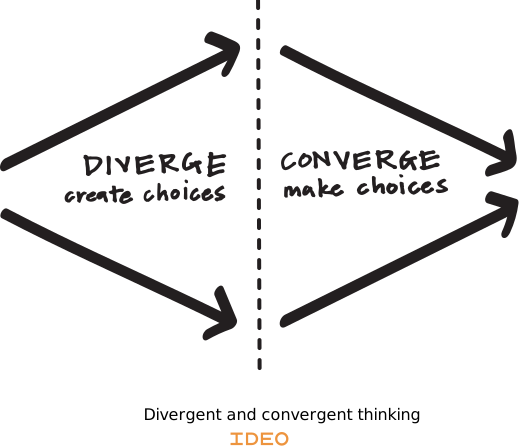
- Ideating: Brainstorming, Divergent-Convergent Thinking, Possibilities, Craziness, Vision, Getting Un-stuck, Strategic Angularity.
- Prototyping: Candidature. Rapid Prototyping (fail early, fail fast).
- Testing: Test plan. Feedback. Closed Loop, Corrective Action. Iteration.
- Communicating: Roll-out. Awareness, Action & Multiple Media (infographic, spec sheet, pitch, ...). Feature Set. Persuasion. Early Adopter target.
- DezignBläst Studio.
- Levels: Beginner-Practice-Leadership.
- Discipline: Focus. Effort. Pace. Stanford-Level Quality Expectations.
- Journey: Open-Explore-Close (Gamestorming). Adventure. Fun.
- Instructional Team
- Students: Huddle in groups of three for 1 minute then find something (interest or background) in common that would be interesting for introductions. Purpose: searching the unknown.
- Convergence Exercise.
- Pick a favorite product. Add sustainability (a) as a capability, or (b) as a characteristic.
- Observe. Define. Ideate. Sketch. Concept Story (narrative). Human-centered.
- Intended to stretch & strain (aka wedging, coning & centering). Manage uncertainties. Do your best. Use design thinking.
- Discuss (Slack), Document (Notion) & Mini-Essay Report (Canvas).
- 10 pt value. Content+Style+Other. Pat-on-the-back? or Wake-up call? #define average = 5. #deductions.
- This is your audition for the DezignBläst Studio Team
- In Notion Design Journal, add a card with selfie photo and highlights-only bio-sketch (preview to design thinking yourself & feature list concept).
- A screenshot of the Notion card must be submitted in Canvas to get the bonus point. PDF, PNG or JPG ok.
- 1 pt value from Staff Discretionary Pool if card screenshot is submitted by deadline.
- 0 pts if not submitted by due deadline.
- Design Thinking Process Step 1: Empathizing - mindfulness, emotional intelligence, observing (IDEO Methods), look & see (Corita Kent), tell a story (Cantor Arts Center), “What adults can learn from kids” (Adora Svitak), Undercover Boss.
- Asking Questions in Design Thinking. Who? What? Where? When? Why? How? Which? How many? Open-ended vs Close-ended questions.
- Draft the first sentence of your personal story. Use your Notion About [your name] card as inspiration. Think scope, frame & worldview.
- In-class Exercise 1: Sketch the scene related to the first 10 minutes after you got out of bed this morning. Annotate details. Share the sketch with another student. Ask questions to add detail & fill gaps.
- In-class Exercise 2: A Message to My Past Self.
- Homework Assignment: Wander. Select a location (must have at least one human in addition to yourself). Observe (30 minutes or longer). Sketch the scene in Notion Design Journal. Use Look & See method. Annotate details explaining forms & functions. Notice any issues, problems or opportunities for improvement. Part A (observational & project ideas notes) due Friday (to screen ideas or domains). Part B (problem statement) due Monday.
- Sign-in sheet with Friday availability to schedule office hours
- Waiting List decisions
- What is a unit? Compressed into 4 hours meeting/wk + ~8 hrs homework/wk.
- Draft the first sentence of your personal story. Use your Notion About [your name] card as inspiration. Think scope, frame & worldview. Awareness. Actions. Self. Social.

- Slack discussion
- Evaluations by Friday (or sooner)
- Canvas rubric
- Empathy Basics: my time in customer service; forgetfulness; patience.


“Learning should be reciprocal.”
- Undercover Boss (TV), Big (Movie) & more…

- “Start where you are. Use what you have. Do what you can.” - Arthur Ashe
- PostIts exposure
- Observation (Look & See)
- Humans (in the frame)
- Symbolism of building
- Discussion about your own and your partner’s emotions and behaviors.
- Who? What? Where? When? Why? How? Which? How many?
- Open-ended vs Close-ended questions.
- Repeats throughout Design Thinking process.
- Sketch the scene related to the first 10 minutes after you got out of bed this morning. Annotate details. Share the sketch with another student. Ask questions to add detail & fill gaps.
- Wander. Select a location (must have at least one human in addition to yourself).
- Observe (30 minutes or longer). Sketch the scene in Notion Design Journal. Use Look & See method.
- Annotate details explaining forms & functions. Notice any issues, problems or opportunities for improvement.
- Part A (observational & project ideas notes in Notion) due Friday (to screen ideas or domains).
- Part B (preliminary problem statement in Notion) due Monday.
- Warm-up Exercise:
- A Message to My Past Self
- Design Thinking Process Step 2: Defining - Focus, Problem, Scope, Need, Composite Character Profile (CCP), Point of View (PoV).
- Discussion about observations & preliminary problem statement from Homework Assignment.
- Refine preliminary problem statement into working problem statement. Does it need more focus or a tighter scope or greater specificity? Checklist against the Asking Questions method.
- Derive needs from the problem statement.
- Development of a Composite Character Profile (CCP).
- Drafting possible point of views (PoV).
- Homework Assignment: tbd

- Office hours this week.
- Is everything working? Slack? Notion? Canvas?
- July 5 (Fri, 5 p.m.) Final Study List deadline.

- Part 1 of 3 of Your Personal Story.
- EQ Self-awareness.
- Self-Definition.
- SkillScan & other self-assessments.
- David Steindl-Rast on Gratitude https://www.ted.com/talks/david_steindl_rast_want_to_be_happy_be_grateful?utm_campaign=tedspread&utm_medium=referral&utm_source=tedcomshare
- Shawn Achor on Positivity https://www.ted.com/talks/shawn_achor_the_happy_secret_to_better_work?utm_campaign=tedspread&utm_medium=referral&utm_source=tedcomshare
- A Message to My Past Self
- Details about the people’s expressions, body language, movement, behaviors & actions.
- How did you empathize? Did you wonder “If it were me…”?
- Discussion about observations & preliminary problem statement from Homework Assignment.

- Speculation: “Start Where You Are. Use What You Have. Do What You Can.”
- Confirmation: Manage uncertainty. Collect information. Validation. Verification. Asking questions.
- Finalization: Your freeze model.
- Focus on Objects
- Focus on Subjects
- Focus on Form & Function
- When you focus on something, something else may go out of focus
- The method of Active Listening: Focused Attention
- From HERE ← to → HERE.
- Describe the scope of the problem in one sentence. Use asking questions design thinking.
- Use your insights from observing. Which insights are surprising & seem to need urgent help?
- Let’s diagram the scope (x1 → x2) of your observations using Who? Where? and When?
- Who? One human characteristic scale (eg, introvert ↔ extrovert).
- Where? Spatial boundary limits. Scenery. Setting.
- When? Day (calendar or event), date & time properties of the model.
- Preliminary Problem Statement
- Working Problem Statement
- Describe a problem in one sentence. Use design thinking. Make sure the problem statement fits in the scope.
- First pass at thinking about needs. Make guesses.
- What needs are associated with your problem?
- Sorting: Must-have vs Nice-to-have vs Low priority
- Needs will be clarified through interviews, surveys, focus groups, & other research investigation
- Optional: Update Needs after CCP step, & before PoV step.
- Create a card in Notion Design Journal
- Add a Sketch or Photo
- Highlights of background, current status, mindset, skillset, biases & preferences
- Point of View: A highly articulated/filtered problem statement for a specific character. Not everyone (inclusive). Not anyone (uncertain).
- Focus on the most salient and relevant characteristics of your potential users.
- Avoid getting distracted by non-essential characteristics.
 Point of View Statements - Tips
[USER] needs to [USER'S NEED] because [SURPRISING INSIGHT]
- Create a card in Notion Design Journal
- Write a point-of-view statement reflecting the character’s problem experience using the user-need-insight structure.
- Optional: Update Needs, CCP & PoV after interviews, surveys, etc.
/w=1920,quality=90,fit=scale-down)
- “How ideas hatch”
- Event Planning d.School example → group planning a 4th of July event or activity
- Form a group of 3 or 4.
- Create a card in the Design Journal.
- Select a social event or activity type for this week’s 4th of July holiday
- Go around the group & take turns making one suggestion for the event/activity. “We should…”
- Note each suggestion in the Design Journal.
- We will continue for ~5 minutes.
- One person from each group will share the group’s event/activity plans with the class.
- Refine your preliminary problem statement into a working problem statement. Does it need more focus or a tighter scope or greater specificity? Checklist against the Asking Questions method.
- 4th of July Event Planning: Preliminary Problem Statement → Working Problem Statement
- Objective: create a composite character profile.
- In your group, share profile highlights (use Bonus Assignment Bio-sketch, if available).
- Write a profile brief for two persons in your group. Include name and highlights.
- Create a composite profile using your real profile briefs. Make sketch and list a few profile highlights (~200 words).
- Note that this exercise does not necessarily connect with your Design Project 1. Your in-class CCP may be used for Design Project 1, if it fits.
- Role-playing Activity; instructors will provide CCPs; volunteers needed.
- Objective: create a PoV for your CCP.
- For your CCP, draft a PoV describing the character’s experience with the working problem statement.
- Problem Statement: Convert your Design Project 1 preliminary problem statement into a working problem statement. 200 word limit.
- CCP: Compose at least 3 diversely different CCPs for Design Project 1. One sketch or photo required & 200 word limit per CCP.
- PoV: Compose 1 PoV for each Design Project 1 CCP. 200 word limit per PoV.
- Create a mini-proposal that comprises a working title (<10 words), the working problem statement, one CCP & one PoV.
- Fast Thinking & Slow Thinking
- Fast Thinking Basics (Learned, Active Recall, Waggle Dance, Associative Architecture)
- 30 Circles
- CCP & PoV still in flux
- Let us confirm our CCP and PoV with interviews and/or surveys.
- DEFINING DESIGN JOURNAL CARD
- INTERVIEWS
- SURVEY
- FREEZE DEFINING
- IDEATING DESIGN JOURNAL CARD
- IDEATE SOLUTIONS USING BRAINSTORMING.
- LIST SOLUTION KEYWORDS. CREATE A SOLUTION TITLE USING KEYWORDS WITH STRUCTURE & FLOW TO AN ACADEMIC PAPER TITLE.
- SELECT TOP 3 SOLUTIONS.
- PROPOSE SOLUTIONS. Include sketch and the solution title.


The Bike-Share Oversupply in China: Huge Piles of Abandoned and Broken Bicycles ALAN TAYLOR • MARCH 22, 2018

Photo credit: Reuters
- Fast Thinking & Slow Thinking
- Fast Thinking Basics (Learned, Active Recall, Waggle Dance, Associative Architecture)
- 30 Circles
- CCP & PoV still in flux
- Use non-leading questions that demonstrate your neutrality on the topic. ie, not Agree/Disagree, but where the respondent stands from neutral.
- Primarily use close-ended questions so activity is not time-constrained. In general, you should be aware of the options.
- Use open-ended questions only if necessary. If possible, reach for quick & reactionary responses.
- Allow for no response or no opinion in the responses. This is still valuable feedback.
- Aim for 5 minutes maximum in length. Especially for design thinking, emotionally-driven responses give the greater insight.
- Include a few demographic questions so that you can categorize the responses & search for trends.
- If face-to-face interviews, try to get 5 or more. For an online survey, try to get 15 or more responses. These targets will be higher for the Design Projects 2 & 3.
- Push, Pull, Center, Grow, Shrink & Other Modes of Change.
- Prepare 5 questions for an interview.
- Conduct your interview with a person in your group.
- Create a Google Form Survey with 5 questions.
- Copy-and-paste the survey form url into Slack Design Project 1 channel.
- Click on the survey url for a person in your group.
- Complete the survey.
- What it means to freeze.
- We want to move to ideation.
- Commit to the Freeze model.
- SOLUTION
- OPPORTUNITY
- COMPETITIVE ADVANTAGE
- THE MODEL
- TEAM

- PART A. DEFINING DESIGN JOURNAL CARD
- INTERVIEWS
- SURVEY
- FREEZE DEFINING
- INFOGRAPHIC
- PART B. IDEATING DESIGN JOURNAL CARD
- IDEATE SOLUTIONS USING BRAINSTORMING.
- LIST SOLUTION KEYWORDS. CREATE A SOLUTION TITLE USING KEYWORDS WITH STRUCTURE & FLOW. STAY WITHIN SCOPE. BE ACCURATE & PRECISE.
- SELECT TOP 3 SOLUTIONS.
- PROPOSE SOLUTIONS. Include one paragraph description, one sketch, and the solution title. Maximum 250 words.
- Make a prototype (physical model & sketches) for Testing next class.
- Document the prototyping work in Notion Design Journal.
- List the form & function features that you want tested.
- Office hours this week


Keywords: Early adopter (Focus), Desirability (I want that, I need that), Impossibility (Innovation), Adoptability (Story), Memorability (Hook)

- Will do this activity later in the course

- User Experience (UX)
- Human-Computer Interaction (HCI)
- Out-of-Box Experience (OOBE)
 Minimum Viable Product
- MVP+: A product that delivers on the promise functionally plus impresses human emotions.
- Draft the MVP. What are the minimum features?
- Draft the MVP+. What is the feature set that will make an impression?
- Make a paper prototype.
- Make a prototype (physical model & sketches) for Testing next class.
- Document the prototyping work in Notion Design Journal.
- List the form & function features that you want tested.
- Design a test plan for your prototype
- In groups, test & give/get feedback
- Document results in Design Journal
- Using your test results, iterate your prototype.
- Conduct test of your iterated prototype.
- Document MVP & MVP+ of your final prototype in Design Journal.
- Office hours this week
Recall at least 12 food items in your home refrigerator.
Write one food item per PostIt.
Randomly pair your PostIts.
If you have an odd number of food items, yiou can create one triple-combination.
Pick the pair that…:
- is most unlikely to succeed.
- is the most unexpected surprise.
- is your favorite flavor combination.
Working with your favorite, give it a product name.
Who would like this flavor? Think target audience.
Group vote on the ice cream flavors.
- Is your prototype ready?
- Test Plan: Script & Time Management; Keep It Simple.
- Constraints
- Success Criteria
- Test Results: Pass/Fail
- Design a test plan for your prototype
- In groups, test & give/get feedback.
- Document results in Design Journal.
- Goal is to have at least 5 test runs in-class.
- Each test run is 10 minutes.
- Using your test results, iterate your prototype.
- Conduct test of your iterated prototype (schedule test sessions with classmates; same or new testers ok); expectation that each student will be tester for at least two projects.
- Document MVP & MVP+ of your final prototype in Design Journal.
- Office hours this week
- Shared Problem
- Positivity, Promise & Ask
- In-class presentation.
- 90 seconds - firm limit.
- Practice. Practice. Practice.
- No Q&A (we will have Q&A for Design Projects 2 & 3 presentations)
- Peer Evaluation (Google Form): Idea, Presentation, Persuasiveness


- Template
- Report on Design Thinking Process & Product (2-page limit)
- Design Thinking Reflection (~250 words)
- Publication-Ready Quality (Bonus Point; incentive)
- Remove Un-necessary Rubric before submitting.
- Due after Elevator Pitch, but should be started together.
- Submit in Canvas.
- Exactly 30-seconds
- Highlights only
- Emphasis on Design Thinking

- Review Design Journal
- Create outline for elevator pitch using PostIt method
- Design Journal notes due in Notion by 2:30 pm on July 15, 2024
- Elevator Pitch delivery in class on July 15, 2024
- Due in Canvas by 2:30 pm on July 17, 2024
- Due in Notion Design Journal by 2:30 pm on July 17, 2024
- Office hours this week
- “Exceptional” comment on some Short Videos. Some lacked design thinking highlights.
- A few Spec Sheets had format issues. Some had content issues.
- Most Self-Reflections were personally aware & insightful. Push more towards human-centered thinking & personal growth-development.
- Peer & Staff Elevator Pitch scores in general agreement.
- Key: 3 = push, 4 = nudge, 5 = refine.
- Overall: Mean 26.445, Std Dev 1.550, Hi 29, Lo 22
- Design Project 1 = Learning Phase, Design Project 2 = Practice Phase, Design Project 3 = ? Phase
- No Short Video for Design Project 2. A 3D Physical Model will be required.
- August 2 (Fri, 5 p.m.) Change of grading basis deadline.
- August 2 (Fri, 5 p.m.) Course withdrawal deadline.
 Design Project 2 | Team-Staff Meeting August 1 & 2, 2024
- Spaghetti Tower Marshmallow Exercise: Lesson in Team Dynamics

Change isn't easy!
While we can often list a bunch of very rational reasons for why someone should want to change, they often resist. When users have choice, we need to assess and help them move through the steps of accepting and acting on the change.
Journey Maps are a very useful framework for:
- capturing the traits of a specific user profile and their needs
- list the steps in the user's journey
- itemizing their needs at each step in the journey
- capturing your assessment of their emotional journey -- how are they feeling? -- at every step of the way
- identifying opportunities to improve the journey
- ideating about ways to deliver on those opportunities
Here are some examples of Journey Maps for:


- Review work plan & action items.
- Start looking ahead to presentation day.
- Deliverables: Elevator Pitch, Spec Sheet with Self-Reflections, & Model.
- Continue Design Thinking Work.
- JOURNEY MAP. Due in Design Journal by 2:30 pm on Wednesday July 31, 2024.
- YOUR PERSONAL STORY: WHO AM I?
- WRITE AN OPENING PARAGRAPH FOR A STORY ABOUT YOU (AS THE MAIN CHARACTER) IN THE SPACE YOU ARE DESIGNING. <100 WORDS.
- REMEMBER WHO? WHAT? WHERE? WHEN? WHY? HOW?
- U-Shaped Table Arrangement for Elevator Pitch
- There is not an in-person final examination.
- Plan for Design Project 3 Spec Sheet Canvas submission.
- Who am I? Centering Exercise
- Order
- Peer Assessment Form
Order | Team Name | Project Name |
Team 1 | ||
Team 2 | ||
Team 3 | ||
Team 4 | ||
Team 5 | ||
Team 6 | ||
Team 7 | ||
Team 8 | ||
Team 9 | ||
Team 10 |
https://forms.gle/67v42A4UAgM4nLaT6
/w=1920,quality=90,fit=scale-down)
- Re-arrange tables.
- Place model, placard & other materials.
- Browse. Leave comments on PostIts.
- Spec Sheet (due in Canvas by 2:30 pm Wednesday August 7, 2024)
- Each team member has to submit their team’s PDF.
- Spec Sheet should contain a design thinking reflection by each team member.
- Check that the Spec Sheet meets format & content requirements.
- Verify that the Spec Sheet uploaded successfully.
- Your Personal Story Part III: A Message to My Future Self
- Design Project 3: Kick-Off
- In case you need an “Incomplete” for this course…
- Good news: No late assignment deduction for Design Project 3 Spec Sheet. Bad news: No late assignments will be accepted.
- Design Project 2 Spec Sheets should be in Canvas.
Your Personal Story Part III: A Message to My Future Self


- Future Designing. The Year is 2054.
- Uncertainty. Imagination. Hopes. Dreams. Aspirations.
- Strategic Angularity. Nudging. Bundling. Dark Patterns.
- Where will YOU be 30 years from now?
Micro-Living.
Micro-Transportation.
Micro-Dining.
Micro-Services.
Micro-Shopping.
Micro-Healthcare.
Fault Detection.
Optimization.
Smart Assistance.
Seniors/Retired/Assisted Living
Disaster Relief/Rescue/Preparedness
Agricultural/Farming
Healthcare (eg, routine, rehabilitation or long-term care)
Educational (but not university dorms)
Family (Urban, Suburban or Rural)
Research & Development (eg, Silicon Valley, Biopolis,…)
Handicapped/Special Needs
Nature-Focused/Preservation/Restoration
Recreation/Tourism/Hospitality/Retreat/Visitor Center
Transitional
Gentrification
Urban Decay & Renewal
Public Housing
Villages
Tribal Reservations
Mobile Communities
Off-the-Grid
Marine
“Villages” (eg, Better Sleep Village or Clear Vision Village or…)
TEAM 1 | TEAM 2 | TEAM 3 | TEAM 4 | TEAM 5 | TEAM 6 |
1 | 7 | 19 | 19 | 24 | 29 |
2 | 8 | 20 | 20 | 25 | 30 |
3 | 9 | 21 | 21 | 26 | 31 |
4 | 10 | 22 | 22 | 27 | 32 |
5 | 11 | 17 | 23 | 28 | 33 |
6 | 12 | 18 | |||
Domain | Domain | Domain | Domain | Domain | Domain |
- Choose a domain.
- Do some quick research.
- Form a preliminary concept. 1-(brief)paragraph.
- Make a “napkin” sketch.
- Create a design thinking work plan.
- Seek approval. Checking for scope that meets future requirement, sustainability design thinking focus, & unified team vision.
- Plans: Floor plan, Community plan, Regional context map
- Models (see below)
- Written summaries: Concept, Design Thinking, Sustainability Messaging, Innovation, Technical Specifications (& more).
- Suggest prepared pitch be <90 seconds. Think “grab” & shared problem. Include promise & ask.
- 3D Physical Interior Model
- 3D Physical Exterior Model
- Digital Model

- Set-up project. Allocate resources.
- Perform tasks: design thinking, design, prototype, document, manage, communicate.
- 1 week of effort by 5 or 6 persons = 5/6 persons x 8 hours = 40/48 hours person-hours total.
- Continue project effort.
- Reminder: Stanford Course Evaluation.
- Grades will be posted by eod Tuesday August 20, 2024.
- Take a team photo at your poster display. Add it to your Team Design Journal. Emphasis on Ownership. If you hover at the top of your team Design Journal, “Add cover” will appear.
- Peer Assessment Form
/w=1920,quality=90,fit=scale-down)
Class Group Photo
Design Thinking Your Life
- Spec Sheet
- Reflections
- Submissions due in Canvas by 6:30 pm on Saturday August 17, 2024. No extensions.

Weight Loss Drugs
AI - Automation
AI - Machine Learning - Decision-making
AI - Graphics
Data Science & Analytics - Control & Prediction
Human Social Isolation - mainstream society
Human Social Isolation - elderly & retired
Disaster Preparedness & Response
Human-Animal Interaction (a play on Human-Computer Interaction, HCI)
Right to Repair
Tiny Homes
Education & Retraining
Reclaimed Water Resource Management
Pushing, Pulling, Centering, Lifting, Lowering, Enlarging, Shrinking, Coloring, Patterning, Joining, Rebranding, Remodeling, Renovating, Restructuring, Reinforcing, Separating, Emulsifying, Blending, Stacking, Decorating, Landscaping, ???
- How to form teams
- Mini-proposal + Work Plan in Canvas or Notion?
Constraints: High-Efficiency, Community, Future
Purpose: Showcase Sustainability Innovations
“So I have a big interest in education, and I think we all do. We have a huge vested interest in it, partly because it's education that's meant to take us into this future that we can't grasp. If you think of it, children starting school this year will be retiring in 2065. Nobody has a clue, despite all the expertise that's been on parade for the past four days, what the world will look like in five years' time. And yet, we're meant to be educating them for it. So the unpredictability, I think, is extraordinary.” - Sir Ken Robinson, TED2006, “Do schools kill creativity?”
Micro-Living.
Micro-Transportation.
Micro-Dining.
Micro-Services.
Micro-Shopping.
Micro-Healthcare.
Fault Detection.
Optimization.
Smart Assistance.
Seniors/Retired/Assisted Living/Memory Care
Disaster Relief/Rescue/Preparedness
Agricultural/Farming
Healthcare (eg, routine, rehabilitation or long-term care)
Educational (but not university dorms)/Sports Specialization/Training/Continuing
Family (Urban, Suburban or Rural)
Research & Development (eg, Silicon Valley, Biopolis,…)
Handicapped/Special Needs
Nature-Focused/Preservation/Restoration
Recreation/Tourism/Hospitality/Retreat/Visitor Center
Transitional
Gentrification
Urban Decay & Renewal
Public Housing
Villages
Tribal Reservations
Mobile Communities
Off-the-Grid
Marine
“Villages” (eg, Better Sleep Village or Clear Vision Village or Memory Village…)
Do a preliminary-type background review using available materials
TEAM 1 | TEAM 2 | TEAM 3 | TEAM 4 | TEAM 5 | TEAM 6 |
Martina | Enrico | Cindy | Rawda | Ishwar | Tom |
Dave | Wui Shuen | Ali | Milo | Alyazia | Lateifa |
Amna | Eric | Vivian | Adelya | Tim | Rowan |
Huwon | Sumaiyya | Matthew | Adam | Therese | Ale |
Nadia | Nick | Warren | Jolene | Yuto | Albert |
Vishal | Alex | Ashley | |||
Nicknames for team members - perhaps in Design Sprint, eg, Colin “Cranberry” Ong. Think Top Gun.
Invite Hailey, Jessica to Design Project 3 presentations
Prior Class Sessions

Planning Notes
What is sustainability?
Cycles and systems
Design thinking process
Eight projects — sustainability in the built environment
- Waste
- water
- Building energy
- Construction
- Well-being
- Land
- Food
- Abbreviated Pitch
- 1 screen infographic
- Physical prototype
- Follow-up Assignment: Summarize in Spec Sheet prior to next Monday session
Domains / Projects for Spring 2024
- Dining Halls
- Cafes / Food Service
- Finding
- Purchasing
- Acquiring
- Use
- Disposal
- Innovation in Dorm Space
- Sleeping / Relaxing (Individual)
- Communal / Socializing (Group)
- Bathing
- Studying
- Eating (decentral)
- Storage
- Walking
- Marguerite
- Bikes - Encourage Use
- Safety
- Availability
- Theft
- Image and Style
- Scooters
- Access to off-campus destinations
- Food Supply — Jessica
- Diet
- Exercise
- Sleep
- Mental Health
Principle
- Sustainability without Sacrifice
Spec Sheet Templates
Colin’s notes for May 22 Class meeting
Ice Cream Flavor Exercise?
Exercise in dream innovation through convergence. Sustainable efficiency in multi-purpose & multi-function design. What other “multi” opportunities are there? Reality Distortion Field.
What do you see in your dorm if you close your eyes now? What do you see in your dorm design? Now mentally squint and what do you see? Imagine a 15-second movie scene.
Connect with OOBE.
Alternate: Proposition of a Chief Detail Officer (Rory Sutherland).
What details make for a sustainability-based dorm experience based on positive human behavior changes? Awareness & action. Aware of who is there (or not there) and the actions that could be taken. For example, a dorm room that monitors air quality & health → uses AI to take or suggest actions. Rory Sutherland examples of train time-savings vs service in Europe, and shape of Shreddies.
Questions for Dorm Designers - human-centered details; talking points for presentation
- What do you like most about your current dorm? Will you preserve this aspect in your design?
- What do you least like about your current dorm? How will you improve on this In your design?
- What did you most like about your dorm on arrival day?
- What did you least like about your dorm on arrival day?
- What do you most fondly remember about adjusting to dorm life?
- What was the most difficult aspect of adjusting to dorm life?
- How long did it take you to decide whether you liked your dorm? What influenced this decision?
- What % of your co-residents would agree with your above thoughts?
- Is there an assigned space in the dorm design for staff?
Sustainability Keywords from Meeting with Haley Todd
trash
reuse
laziness (or is it apathy/priorities?)
single stream recycling
fellows/interns
worst day is check-in day esp box cardboard disposal
bicycle donation
cultural (sustainability) mindset
Digital Twin:
- vs an Analog Twin. The DT would focus on specific features. Example is the MVP or the Feature List (highlights) product.
- vs another Digital Twin. Twins can be identical or fraternal. Birthed together, raised together, and best if compatible. Applies to the dorm neighborhood.
Master Databases


Longevity, by Design
“Today, Apple published a whitepaper explaining the company’s principles for designing for longevity — a careful balance between product durability and repairability.”
→ I don’t think durability and repairability are definitively opposing. And neither is definitively a critical aspect of longevity.
→ by using the word “balance”, the statement implies the product is not 100% (best)of either.
→ “The longevity of Apple products continues to increase. There are hundreds of millions of iPhones that have been in use for more than 5 years — and that number is still growing. And Apple products remain in use longer than competitor devices.” Note how first and last sentence says “Apple products”, but second sentence provides support only for iPhone. This is an association fallacy. The design thinking is muddled.
Apple 2030 A plan as innovative as our products.

→ What do you think about the design thinking of this web page?


Therese, Yuto and Vishal absent on Monday August 12